Showing posts with label Bangladesh. Show all posts

Sunday, July 10, 2016

Ontorjatra, directed by Tareque and Catherine Masud

Ontorjatra
Bangladesh (Bengali and English), 2006
84 min, slice-of-life, drama
Directed by Tareque and Catherine Masud
Starring Sara Zaker and Rifakat Rashid

After 15 years abroad, Shireen and her son Sohel return to Bangladesh to attend the memorial service for Sohel’s father. After getting a divorce when Sohel was five years old, Shireen had fled to the UK and cut off any communication with her ex-husband. This included allowing Sohel to visit Bangladesh or communicate with his father in any way.

Bangladesh is not like Shireen remembers, and Sohel is experiencing it for the first time. As Sohel discovers the family that he never knew, Shireen is forced to confront her past and the decisions she made all those years before.

This is a major, well-known Bangladeshi movie. I wouldn’t call it a good movie, necessarily: the acting, in particular, leaves a lot to be desired, and there are far too many voiceovers. However, it does a very good job of showing what life in Bangladesh is actually like – and that is what I want to focus on.


Dhaka


I have told my husband many stories about Dhaka and Bangladesh, but he’s never been there. I was surprised when he started exclaiming about things that he noticed in this film. “The airport is so 1970s!” “The buses are so beat up, they look terrible!” “God, this is what the traffic really looks like???” I guess my descriptions didn’t convey as much as this video did.

This movie gives a good sense of what it feels like to be walking around in Bangladesh and interacting with Bangladeshi people there. Dhaka is full of too many people, too much traffic and too much pollution, and it’s constructed out of new high-rise buildings, with older buildings few and far between. But if you go outside of Dhaka, the countryside is beautiful – green rice fields stretching into the distance and the tea gardens in Sylhet.


Read the rest at The Asian Cinema Blog


Want to see more reviews of world literature and film? Follow me on Twitter or like The Globally Curious's facebook page!

Sunday, December 27, 2015

Uttarer Sur (The Northern Symphony), directed by Shahnewaz Kakoli

Uttarer Sur (The Northern Symphony)
Bangladesh (Bengali), 2012
113 min, drama, social commentary
Directed by Shahnewaz Kakoli

Chan Miya is a traditional folk musician who plays the dotara, a stringed instrument, and performs songs from the "Bhawaiya" tradition of Northern Bangladesh. He lives in a rural village with his wife Ambia and their daughter Ayesha, who is learning to perform as well. While the amount of money he earns from playing his music in train stations and markets is quickly diminishing, he has pride in his art and is hesitant to take up the more lucrative manual labor that is available in the village. Chan Miya dotes on his daughter and finds it difficult to refuse any of her requests - even when she wants to buy pet pigeons with the little bit of money they have for food.

Ambia, an orphan with skin that is considered far too dark, comes from an abusive background. The lack of food and her societal role as the artist's wife is taking a toll on her, and she is angry with her husband and daughter when they spend their tiny income on frivolities. She wishes she could go to work herself, but it would be a shame for the family if people know that Chan Miya is unable to provide for them through his art.

While this movie has some major flaws, I have chosen to review it because it depicts the difficulties faced by traditional musicians in a rapidly changing part of rural Bangladesh.


Wednesday, September 23, 2015

Ghetuputro Komola (Pleasure Boy Komola) directed by Humayun Ahmed

Ghetuputro Komola (Pleasure Boy Komola)
Bangladesh (Bangla), 2012
101 min, historical drama, LGBT+, psychological, musical
Directed by Humayun Ahmed

In colonial-era Bengal, a Muslim zamindar (landowner) hires a musical group to entertain him during the monsoon, when flooding makes it difficult to travel or work. The group performs in the "Ghetu" musical tradition, which combined folk music and dancing with a special performance by young boys dressed as women. Zamindars hired "ghetu" groups for both the musical diversion they could provide and the sexual services of the "ghetu" boys.

In this case, Jafir, who goes by the "ghetu" name Komola, arrives with his father (the head of the troupe) and other musicians. Despite their class differences, he makes friends with the zamindar's daughter, who is about the same age as him. But the zamindar's wife hates Jafir for stealing her husband's affections. In this complicated domestic situation, Komola/Jafir must do her/his job, and make enough money to keep his family fed for the foreseeable future.

This is the last movie made by noted Bangladeshi author and filmmaker Humayun Ahmed, and it was the official Bangladeshi nomination for the Foreign Language Oscar at the 85th Academy Awards.


Sunday, August 23, 2015

Caged in Paradise and Other Stories by Rizia Rahman, edited by Niaz Zaman and Shirin Hasanat Islam

Caged in Paradise and Other Stories
Edited by Niaz Zaman and Shirin Hasanat Islam
Translated from Bengali
2010
215 pages, short stories, drama, realism, satire

Thank you to UPL for providing a review copy of this book. 

Full Disclosure: I am currently doing an internship with the publisher which includes marketing products including this one. However, the views presented here are my own. 

When I brought up the idea of promoting some literature for Women in Translation Month, my boss's face lit up. "I know the perfect one!" she said, and recommended this short story collection. While paging through the collection to find quotes that we could use for marketing, I found myself being mesmerized by the stories; after skimming the first fifty pages or so, I immediately asked for a review copy. And I was not disappointed - this book, it turns out, is one of my absolute favorite story collections.

Rizia Rahman is a renowned Bangladeshi author. She has been writing short stories and novels since the late 1960s, and received the Bangla Academy Award, the top literary award in the country, in 1978. Before picking up this book, I had never heard of her. Now I'm thinking about buying one of her novels in the original Bengali before I leave the country next month.

The stories in this collection span the length of her career. They deal with personal challenges, community grief, village politics, changing social mores, women's and human rights discussions. Whereas her earlier stories are more straightforward, demonstrating realistic and relatively linear storytelling, her newer ones move toward magical realism and impressionism. All are handled with marvelous skill, providing glimpses of everyday (and not-so-everyday) life in Bangladesh.

Sunday, November 2, 2014

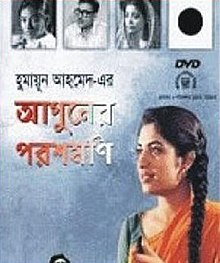
Aguner Poroshmoni directed by Humayun Ahmed

Source: Wikipedia
Aguner Poroshmoni
Bangladesh (Bengali), 1995
123 min, war
Director: Humayun Ahmed
Aguner Poroshmoni (1995) on IMDb


The first film directed by the late Humayun Ahmed, a famous Bangladeshi novelist and director.

Caught in the middle of a genocide, one family struggles to survive


1971, East Pakistan: the Bengali guerilla fighters of the Mukti Bahini are engaged in a life-or-death struggle with the Pakistani army. In what was later termed a genocide, the Pakistani military had launched an operation to suppress the Bengali nationalist movement in May 1971. They targeted intellectuals, civilians, students, and activists, brutally murdering them and burying them in mass graves. Many women were captured and used as sex slaves by the soldiers. When the Bengali people realized what was happening, many fled to take refuge in India. Some returned with weapons as part of the Mukti Bahini, using acts of terrorism and guerilla warfare to counter the overwhelming Pakistani force. This struggle ended by the end of the year, with the result of Bangladesh gaining independence from Pakistan. The war, then, is called the Bangladesh Liberation War.

In the midst of this terrible situation, one family in Dhaka is trying to live life as normally as possible. But then the father brings home a man, a stranger that the family has never met before. They soon discover that he's a member of the Mukti Bahini. They must decide whether to help him and endanger themselves, or to make him leave and probably be killed. 

The full film (without English subtitles, unfortunately) on Youtube: