This movie focuses on a Muslim family in Kerala, India, which had been important in the past but had fallen out of power because of the death of the patriarch. At this point there are four generations living together from this one family. For simplicity’s sake I will refer to them as the grandmother, the mother, the daughter, and the granddaughter. There is also a grandson who is younger than the granddaughter, and who is the pride and joy of this otherwise poor family.
The plot of the movie concerns these four generations of women and how they deal with the patriarchal Muslim and Malayali society that they live in. They have to realize their own autonomy while still being circumscribed by the men in their lives, specifically the dead grandfather and the young boy.
Social ostracism
At the very beginning of the movie, the daughter is summarily divorced by her husband with the support of some village elders. Even before this, he had not been contributing to the family, and they were suffering because of this. Not only are they having trouble because of not being able to afford food, etc., but they are treated badly by the other members of the community because of their poverty. For example, when the grandson visits a friend from a wealthier house he is forced to sit on the floor to watch TV; he is not allowed to sit on the furniture.
Dangal
India (Hindi), 2016
161 min, sports movie, biography
Directed by Nitesh Tiwari
Starring Aamir Khan, Fatima Sana Sheikh/Zaira Wasim, Sanya Malhotra/Suhani Bhatnagar
After he is forced by financial circumstances to give up his own wrestling career, Mahavir Singh Phogat plans to train his future son(s) so that they will win a gold medal for India on the international stage. When he ends up having four daughters, he thinks his dream is lost – but then he has the radical idea that girls can be wrestlers, too. After many years of intense training, he manages to bring two of his daughters, Geeta and Babita, to the international level. But will his old-fashioned, village methods work against athletes from around the world?
This movie tells the true story of Geeta Phogat, the first Indian woman wrestler to win a gold medal at the Commonwealth games (in 2010), her sister Babita Kumari, also a gold medalist, and their father who coached them to greatness.
The Cultural Context
This film does a good job of showing the cultural context and why, exactly, this family is so remarkable. Mahavir and his family live in a village in rural Haryana, India – a state known for its poor treatment of girls, and high rates of female infanticide. Haryana has one of the worst sex ratios of any Indian state: 861 women for every 1000 men in the whole population, and 835 girls for every 1000 boys aged 0-6 years. Patriarchy, especially the wish for male children to carry on one’s legacy, is particularly strong. The movie demonstrates this cultural pressure for male heirs through a humorous sequence, in which Mahavir receives innumerable bits of advice on how to conceive a male child. In the end, it seems to be a catastrophe for the entire village when all of these efforts fail and Mahavir’s wife continues to have girls.
Lucky is a young, good-hearted plant scientist with one major flaw: a mental disorder that makes him get distracted incredibly easily. This interferes with his life in various ways, and now it is interfering with his ability to find a girl and get married. When his father arranges for Lucky to meet the father of a prospective bride, Lucky gets distracted by a series of random events in full view of his prospective father-in-law – leading him to believe that Lucky is a terrible human being.
When Lucky accidentally runs into the girl, Nandana, he falls in love and tries to conceal his problem of forgetting everything. Many of his actions turn into (or are passed off as) incredible philanthropy, and Nandana falls in love with him partially because of his apparent goodness. But how long can he keep this up? Will he ever get the girl?
Disability
Lucky’s habit of forgetting things is treated as a disability throughout the film – and not just because he thinks he has to hide it. Throughout his life, his father has told him that he will never amount to anything, or be able to get married, because of his forgetfulness. And it does significantly impact his life - he has trouble carrying out the simplest tasks because he forgets about them halfway, and he has a lot of trouble with accidentally giving away his belongings – including his father’s car!
When Rani’s fiancée breaks up with her two days before their wedding, she decides to go on the honeymoon by herself. Her first time outside the country, and her first time really alone, gives her the opportunity to explore who she is and what she wants from life.
While in many ways this film draws upon problematic stereotypes of “life in the West,” it still provides a good example of a sheltered young woman steering her own life for the first time.
Self-exploration
In Delhi, Rani lives a sheltered and protected life. Her younger brother acts as her chaperone, especially when she meets Vijay, her fiancée. It seems like her match with Vijay was only partially of her own accord: she wanted an arranged marriage, and this marriage seems to be half-arranged. I’m not sure she really considered any alternatives before making the decision, since she just took marriage as a matter of course.
When Vijay dumps her, she is devastated. She curls up in a ball and cries in her room for a whole day. But she emerges with a decision: she was really looking forward to going to Paris, and had even spent all of her life savings on the ticket – so she wants to go. At this point, she still gives her parents the veto decision, but her father realizes that she needs to do this for herself. Hesitantly, they drive her to the airport and send her on an adventure without them.
At first Rani is incredibly overwhelmed, lonely, and just wants to go home, but then she makes friends and begins to enjoy herself. As she does so, she realizes that she doesn’t need a man to have fun or to travel. She also realizes that some of the assumptions she was making about other people were wrong. For example, although she has been taught that all men are scary, she ends up befriending her three male roommates at a hostel in Amsterdam. Over the course of the film, as she continues to try new things, she becomes less afraid and more independent.
The Indian jerk boyfriend
This film directly addresses one of my pet peeves about Indian movies: the valorization of abusive (even stalker!) boyfriends. After Vijay dumps her suddenly, with no thought about her feelings, Rani accidentally sends him a picture. Seeing this selfie, Vijay suddenly realizes that he actually still loves her. He begins calling her repeatedly, and even goes to Paris and then Amsterdam to track her down.
At first, Rani doesn’t know what to do about this. She is angry, but society has taught her that she should forgive him. When he suddenly appears in Amsterdam, she is willing to talk to him privately - even after he tries to beat up one of her new friends in a fit of over-possessive stupidity! Finally, at the end of the film she realizes that his behavior is not acceptable and that he does not deserve her.
My biggest problem with this film is the incredibly stereotypical depiction of the West. As usual, Rani’s character exploration is accompanied by large amounts of drinking, clubbing, and visiting red light areas (in Amsterdam, of course). Like other films of this genre, it seems like the only way Rani can loosen up is by literally wearing less clothes and drinking. Obviously, this isn’t all that happens in the West – but if you watch Indian movies you would be forgiven for thinking so.
Rani has two potential love interests in Amsterdam, one an Italian restaurant owner and the other one of her roommates. Of the three roommates, the one who catches her eye is the only white person; the others are a black Frenchman and a small Japanese man. The depiction of the Japanese character fits into the racist depiction of Asian men as cute but sexually unattractive; the Black character has barely any speaking lines. It is the hot, emotional, artistic, very white Russian who catches her eye. This reinforces the idea that the only foreigners worth dating or marrying are white people – an idea that is quite prevalent in Indian society.
Despite these rather significant problems, the powerful portrayal of Rani’s voyage of self-discovery makes this movie worth watching. I recommend it as an exploration of how being alone teaches you about who you really are.
Want to see more reviews of world literature and film? Follow me on Twitter or like The Globally Curious's facebook page!
Content Warning: Discussion of Emotional and Physical Abuse
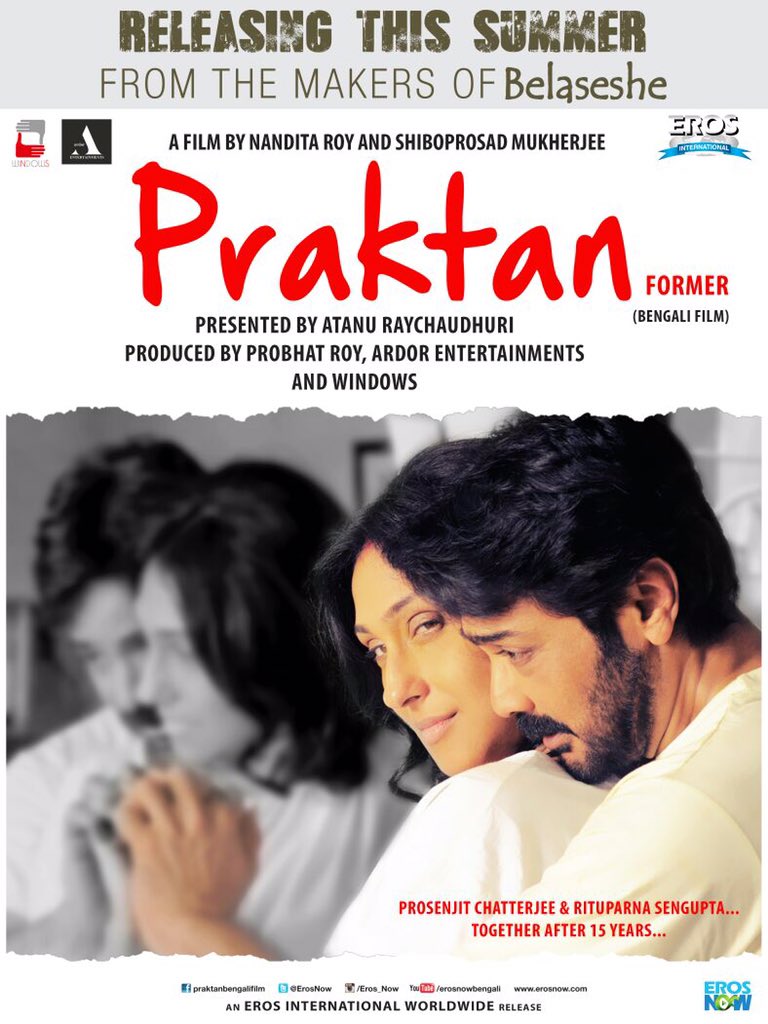
Ten years ago, Sudipa and Ujaan divorced after a difficult marriage. Today, Sudipa finds herself in a first-class train carriage from Mumbai to Kolkata with Malini, Ujaan’s new wife, and their daughter. During the course of the two-night train journey, Sudipa finally deals with the pain from years before.
Meanwhile, we see the stories of people in other rooms in the same carriage. Four famous Bengali musicians (Surojit Chatterjee, Anindya Chatterjee, Upal Sengupta, and Anupam Roy, playing themselves) serenade each other with new compositions. An elderly couple returns from Mumbai after seeing their son off to the US. And last but not least, a couple of newlyweds put the trip in a private cabin to good use.
Both an intimate story of pain, heartbreak, and healing, and a glance at the things that happen in first class, this is a new, great train movie from West Bengal. However, the ending left a bad taste in my mouth.
Court India (Marathi, Gujarati, Hindi, English), 2014
116 min, drama, satire, realist
Directed by Chaitanya Tamhane
Starring Vira Sathidar, Vivek Gomber, Geetanjali Kulkarni, and Pradeep Joshi
An elderly folk singer is arrested for political reasons. What follows is an intimate look at the Indian legal system from the perspective of the three main participants: the defending attorney, the prosecutor, and the judge.
This film won Best Feature Film in the Indian National Film Awards and was India’s official entry for the Academy Awards.
Not a “Courtroom Drama”
I was rather disappointed when I first saw this film, and I think the main reason was its advertising as a “courtroom drama.” I was expecting it to be similar to great “courtroom drama” films like 12 Angry Men or To Kill a Mockingbird. But it isn’t like that at all.
Ontorjatra
Bangladesh (Bengali and English), 2006
84 min, slice-of-life, drama
Directed by Tareque and Catherine Masud
Starring Sara Zaker and Rifakat Rashid
After 15 years abroad, Shireen and her son Sohel return to Bangladesh to attend the memorial service for Sohel’s father. After getting a divorce when Sohel was five years old, Shireen had fled to the UK and cut off any communication with her ex-husband. This included allowing Sohel to visit Bangladesh or communicate with his father in any way.
Bangladesh is not like Shireen remembers, and Sohel is experiencing it for the first time. As Sohel discovers the family that he never knew, Shireen is forced to confront her past and the decisions she made all those years before.
This is a major, well-known Bangladeshi movie. I wouldn’t call it a good movie, necessarily: the acting, in particular, leaves a lot to be desired, and there are far too many voiceovers. However, it does a very good job of showing what life in Bangladesh is actually like – and that is what I want to focus on.
Dhaka
I have told my husband many stories about Dhaka and Bangladesh, but he’s never been there. I was surprised when he started exclaiming about things that he noticed in this film. “The airport is so 1970s!” “The buses are so beat up, they look terrible!” “God, this is what the traffic really looks like???” I guess my descriptions didn’t convey as much as this video did.
This movie gives a good sense of what it feels like to be walking around in Bangladesh and interacting with Bangladeshi people there. Dhaka is full of too many people, too much traffic and too much pollution, and it’s constructed out of new high-rise buildings, with older buildings few and far between. But if you go outside of Dhaka, the countryside is beautiful – green rice fields stretching into the distance and the tea gardens in Sylhet.
Cinemawala
India (Bengali), 2016
105 min, drama, dysfunctional family
Directed by Kaushik Ganguly
Starring Paran Banerjee, Parambrata Chatterjee, and Sohini Sarkar
Pranabendu Das was the proud owner of a single-screen theater in one of the rural suburbs of Kolkata until it went out of business upon the advent of digitalization. Now, with his trusty employee Hori, Pranabendu constantly laments the downfall of old-style theater and his son Prokash’s abhorrent trade of selling pirated DVDs.
Now Pranabendu and Prokash barely speak to each other, and Prokash’s wife Moumita is stuck in the middle. When Prokash gets a brilliant idea to make more money illegally, how will his principled father react?
I saw this movie in a traditional single-screen theater in Kolkata with Tintin and his 80-year-old aunt. This was the perfect place to see this movie, both because of the theme and because some of the shots of the theater in the film lined up perfectly with the seating arrangement in front of us. However, I found little to like in the film itself.
The Ultimate Dysfunctional Family
If you like depressing movies about incredibly dysfunctional families, this one might be up your alley. Prokash and Pranabendu hate each other. They never speak to each other, despite living in the same house. Prokash is resentful about having to provide food for his aged father, especially because his father hates how he makes the money. He also thinks his father is stupid because he did not upgrade the theater as Prokash recommended and considers it his father’s fault that he had to take up selling pirated DVDs.
Pranabendu not only hates his son, but also gets drunk every night and reminisces about the glory days of the theater. He is definitely out of touch with reality, and this has apparently caused his wife, Prokash’s mother, to abandon him and move to Kolkata. Prokash’s mother is currently taking care of her own father, who is senile and partially paralyzed because of a stroke. Prokash apparently only visits his mother when there is some big news; otherwise, she never hears from him.
And then there is Moumita, Prokash’s wife, who takes good care of her father-in-law. They have a good relationship, but it is constantly sabotaged by the ongoing row between the father and son.
Piracy and Paying the Creators
One good thing that this movie does is point out the problems with piracy. Not only is Prokash doing something illegal but, as his dad points out, it also takes away any profit that the creators may have received. This is an important message in India today, where piracy, plagiarism, and other kinds of intellectual theft are commonplace.
I did not see anything likable about this movie, but if the description I have given above seems attractive, go ahead and watch it. And, just out of curiosity, I would be interested in hearing your opinion of the film.
Sardaarji
India (Punjabi), 2015
140 min, comedy, fantasy, romance
Directed by Rohit Jugraj
Starring Diljit Dosanjh, Neeru Bajwa, and Mandy Takhar
Jaggi, or “Sardaarji,” is a talented ghost hunter from rural Punjab, India. Emotionally immature, he is waiting to find his “queen witch:” the prettiest and most wonderful female ghost, who he will add to his bottled collection.
When he gets a call for help from a rich expat family living in the UK, he flies to London to exorcise a ghost from a castle. The ghost turns out to be a Punjabi named Pinky, and Jaggi decides that she will be his queen ghost.
There’s only one small problem: before Pinky will leave the castle, Jaggi must romance Jasmine, a real, human girl – something that terrifies the intrepid ghost hunter.
Emotional Immaturity
I had great suspicions about Jaggi (and the writers) at the beginning of the movie. It seemed like the women were being treated in a very patriarchal way: the female ghosts are literally kept in bottles in a cabinet while Jaggi flirts with them and makes sexual innuendos. This is incredibly problematic, but it turns out that most of this can be chalked up to his emotional immaturity: emotionally, Jaggi is about as mature as a 13-year-old, if that.
This becomes most obvious when Pinky’s plan requires him to learn salsa dancing from Jasmine. She takes his hand and places it on her back in the correct position for ballroom dancing. Jaggi nearly faints and runs away. The reason? He has apparently never touched a girl before – well, except for the she-ghosts, who are ghosts so it doesn’t count – so he is terrified when Jasmine touches him.
This emotional immaturity is indicated in several more minor ways throughout the film. For example, Jaggi’s outfits swing radically between a full suit-and-tie and footie pajamas. He constantly has to ask ghosts for advice, especially about relationships, and only realizes that he is in love when a random ghost tells him so.
Neerja
India (Hindi, English, Arabic), 2016
122 min, thriller, biography
Directed by Ram Madhvani
Starring Sonam Kapoor and Shabana Azmi
On September 5th, 1986, Palestinian terrorists hijack Pan Am flight 73 while it waits on the tarmac at the Karachi airport. The head purser of the flight, Neerja Bhanot, tries to keep the passengers safe by negotiating with the terrorists and trying to outwit them. Based on a true story, this movie depicts how Neerja became an international hero by saving the lives of most of the passengers and crew, while dying herself. Meanwhile, we see the emotional fallout at home of knowing that your daughter, sister, or girlfriend is in mortal danger – and there’s nothing you can do to help her.
While this could have easily become melodramatic, the powerful performances of Sonam Kapoor as Neerja and Shabana Azmi as Neerja’s mother imbue this film with the right mix of tension, fear, and bravery to make it one of the most lifelike and emotionally complex films I have ever seen. I think this is the only movie that has left me bawling in my seat at the movie theater, and I daresay you will have a similar experience.
Neerja’s history of abuse
While it doesn’t go into great detail, the movie does explore Neerja’s history of surviving intimate partner violence. After having an arranged marriage, she is taken to Oman by her husband, who proceeds to verbally and emotionally abuse her – finally escalating into physical violence. Part of this abuse is letters sent to her father demanding that he give more money for her dowry. When Neerja escapes from this terrible situation and returns to her parents’ house, she has to deal with the social and familial censure of her actions. As a woman, she should have been able to accept and adjust to any situation, or so the logic goes. Neerja bravely perseveres in doing what is right for her: getting a divorce, picking up her modeling career again, joining PanAm as a stewardess, and just generally creating a new life for herself.
India (Bengali), 2015
109 min, drama
Directed by Debaditya Bandyopadhyay
Starring Mithun Chakraborty and Dhritiman Chatterjee
How do you make a movie about Naxalites boring? Focus on their middle class struggles.
No, really.
What could have been an interesting film about people with a history of violence and revolutionary feelings in present-day Bengal quickly falls apart into a disjointed, incomprehensible massacre of a movie. I mean that in the worst way possible.
An elderly mine owner asks the famous detective Byomkesh Bakshi to solve a case for him: someone attacked and almost killed a labor leader in his mine, and he is afraid that there is a plot to ruin his business. When Byomkesh and his assistant arrive in the mining town incognito as guests of their client, they discover that there has been a murder carried out in an almost identical way to the attack on the labor leader – and one of the prime suspects is their client’s adult son.
This is a solid detective movie, based on one of the most popular Bengali detective characters (of which the most famous is Satyajit Ray’s Feluda). It was my first introduction to Byomkesh, and I quite enjoyed the character. One thing that most appreciated is that he wears a dhoti, the old-fashioned Bengali Hindu garment, rather than pants, which are more common and considered more professional. When other characters look down on him for being old-fashioned, he just smiles and takes advantage of their disdain. It is quite refreshing to see the dhoti's current meaning subverted in this way.
The women in this movie have prominent roles, even though they are mostly depicted protecting their men. The mine owner’s daughter-in-law, for example, is smart and knows who Byomkesh is, even though he has arrived under a pseudonym. She approaches the detective for help determining whether her husband is guilty of murder. She does not do this because she wants Byomkesh to help him get out of trouble; no, she is terrified that her husband is a murderer and she wants Byomkesh to find out the truth so she can decide on her next step. This is not a passive woman begging for help to clear her husband's name, but a woman who has found herself in a bad situation and who wants more information before deciding what to do about it.
I won’t say any more because of spoilers, but I recommend that you watch this movie if you like detective fiction. The 1960s setting captures the feel of the original stories, resulting in both a solid detective movie and a good introduction to one of Bengal’s famous fictional detectives.
Chan Miya is a traditional folk musician who plays the dotara, a stringed instrument, and performs songs from the "Bhawaiya" tradition of Northern Bangladesh. He lives in a rural village with his wife Ambia and their daughter Ayesha, who is learning to perform as well. While the amount of money he earns from playing his music in train stations and markets is quickly diminishing, he has pride in his art and is hesitant to take up the more lucrative manual labor that is available in the village. Chan Miya dotes on his daughter and finds it difficult to refuse any of her requests - even when she wants to buy pet pigeons with the little bit of money they have for food.
Ambia, an orphan with skin that is considered far too dark, comes from an abusive background. The lack of food and her societal role as the artist's wife is taking a toll on her, and she is angry with her husband and daughter when they spend their tiny income on frivolities. She wishes she could go to work herself, but it would be a shame for the family if people know that Chan Miya is unable to provide for them through his art.
While this movie has some major flaws, I have chosen to review it because it depicts the difficulties faced by traditional musicians in a rapidly changing part of rural Bangladesh.
When her warrior husband is shot in the back of the neck, leaving him unconscious, a woman must care for him as much as possible while in the middle of a war zone. While she takes care of him, she is surprised to find herself confessing everything to him, telling him everything about her cares and desires – even about her sexual explorations - for the first time.
Woman’s roles
The most striking thing about this film is the way women’s roles are depicted. This woman is a good wife – she was engaged to her husband since childhood, married his dagger while he was at war, gave him two children, and is now taking care of him while he is in a coma, despite the risk to herself. She is devoted to him as a good wife should be, begging him not to leave her alone.
At the same time, she has been abandoned by his family. When he was injured, his mother and brothers did not help at all. They left her behind to take care of her husband, knowing that their neighborhood was going to be an active war zone. She quickly runs out of money and has to take refuge with her own aunt. While she fulfills her wifely role to the letter, she is apparently seen as disposable by the rest of her husband’s family.
Jamai Babu
British India (silent with English, Bengali, and Hindi titles), 1931
23 min, slapstick comedy
Directed by and starring Kalipada Das
In this Charlie Chaplin-inspired silent film made in Calcutta, the country bumpkin Gobardhan arrives in the city, is confused by the traffic and noise, believes that a “no nuisance” sign is an address, and fakes illness to spend more time at his in-laws' house so he can sleep with his wife. This is the only surviving Bengali silent film, accidentally rediscovered by Mrinal Sen’s film crew while shooting on location in 1980.
Three versions
One of the most interesting things about this film is the multilingual titles. Like all silent movies, this one has title slides interspersed with the filmed sequences to provide context, narration and dialogue. But because of the multilingual milieu in which it was made, Jamai Babu has titles in three languages - English, Bengali, and Hindi – and they say slightly different things! This provides an interesting opportunity to analyze a film that was originally made in three different languages.
For example, at 4:44, the English-language titles say "What's this Amulda- are you not taking me with you?" but the Bengali titles say "What's this Amulda - you're leaving, are you not going to show me the city?" I don't know Hindi, but I expect that the Hindi version also says something slightly different. This difference is important because the next title screen contains the reply, in which Amulda says that he will show Gobardhan the city later. In the English version, this is a somewhat confusing reply, since the tour has not been mentioned before; in the Bengali version, however, it makes complete sense. Comparing the English and Bengali versions throughout the film, the Bengali version usually provides more context and humor, whereas the English one sounds overly formal and simplified.
When this film was first made, how did multilingual people negotiate these titles? Did they ignore all but one language, or read two or three and combine them to make a composite story? I have no idea, but it would be fascinating to find out.
Laura returns to the now-abandoned orphanage where she spent her childhood, planning to open a home for disabled children with her doctor husband, Carlos. They bring along their son, Simón who doesn't yet know that he is HIV positive and adopted.
Soon after arriving in their new home, Simón begins acting strangely. He suddenly has new, invisible friends, who reveal the secret of his adoption and his illness to him. After a fight with his mother during their business's opening party, Simón disappears. Laura will stop at nothing to find her son, and in the process discovers the secrets hiding behind her childhood in this house.
Ghetuputro Komola (Pleasure Boy Komola)
Bangladesh (Bangla), 2012
101 min, historical drama, LGBT+, psychological, musical
Directed by Humayun Ahmed
In colonial-era Bengal, a Muslim zamindar (landowner) hires a musical group to entertain him during the monsoon, when flooding makes it difficult to travel or work. The group performs in the "Ghetu" musical tradition, which combined folk music and dancing with a special performance by young boys dressed as women. Zamindars hired "ghetu" groups for both the musical diversion they could provide and the sexual services of the "ghetu" boys.
In this case, Jafir, who goes by the "ghetu" name Komola, arrives with his father (the head of the troupe) and other musicians. Despite their class differences, he makes friends with the zamindar's daughter, who is about the same age as him. But the zamindar's wife hates Jafir for stealing her husband's affections. In this complicated domestic situation, Komola/Jafir must do her/his job, and make enough money to keep his family fed for the foreseeable future.
This is the last movie made by noted Bangladeshi author and filmmaker Humayun Ahmed, and it was the official Bangladeshi nomination for the Foreign Language Oscar at the 85th Academy Awards.
XXY
Argentina (Spanish), 2007
86 min, drama, sexual exploration, intersex, LGBT
Directed by Lucia Puenzo
Trigger warning for discussion of sexual violence.
Alex, a young intersex person who has been raised female, lives with her mother, Suli, and her father, Nestor, in a small village on the Uruguayan seaside. (The movie uses female pronouns for Alex, so I do too.) When Alex reaches the age of 15, Suli invites some friends from Argentina to visit. What Alex's father doesn't know is that the husband of Suli's friend is a well-known surgeon known for doing sex-change surgeries. Suli has asked them to come as a secretive consultation about Alex.
Alex is uncomfortable with her mother's plan, and has secretly stopped taking the hormone pills prescribed to make her body look more female. When the other family arrives, she confronts their teenage son, Alvaro, asking him to have sex with her. When he refuses, she later imitates it again and they end up having anal sex with Alex as the penetrative partner. Nestor catches a glimpse of this activity. Not knowing how to respond, he seeks the advice of the friendly neighborhood intersex person, who is married and runs a gas station.
Meanwhile, rumors about Alex's unusual genitals (she has both male and female reproductive organs) are starting to spread - started, it seems, by her former best friend. Before the start of the film, she had confronted him about it and broken his nose, leading her to be suspended from school. As Alex is walking along the beach, a group of bullies arrives and assaults her. They pin her down and open her shorts to reveal her genitals. She is only saved from being gang raped by the arrival of her former best friend, who had realized what was happening and arrives to help.
In the aftermath of this sexual assault, Alex must choose whether to tell her story to the police or continue to hide who she is. What will she decide?
The Humpbacked Horse
Soviet Union (Russian), 1947
57 min, animation, children's, folktale, fantasy
Directed by Ivan Ivanov-Vano
When Ivan's brothers assign him to watch for the creature that is destroying the crops, he discovers that the culprit is a magical white horse with a flowing mane. He climbs on her back, and in exchange for her freedom the horse gives him two beautiful black stallions and a small humpbacked pony.
This pony is magical, intelligent, and can talk. Ivan sells the magnificent stallions to the tsar. When no one else can manage the beautiful, wild horses, the tsar hires Ivan to take care of them - replacing the man who used to have that job. But when the previous groom whispers terrible rumors into the tsar's ear, Ivan is sent on fantastic quests: to capture a fire bird, to bring back a tsar-maid, and to retrieve the tsar-maid's ring from the bottom of the ocean. He accomplishes each one with the help of his magical humpbacked horse.
When the tsar-maid refuses the tsar's offer of marriage due to his advanced age, the tsar begs her to reconsider. She tells him that if he bathes in three cauldrons, one full of boiling milk, one of boiling water, and one of cold water, consecutively, he will grow young and handsome again and she will marry him. Fearing for his own life, the tsar orders Ivan to try this task first. He once again succeeds thanks to his friend the magical horse, and ends up marrying the tsar-maid himself.
This is the first full-length animated feature to be made in the Soviet Union. Based on a famous poem originally published in 1834, all of the lines are in verse. The animation and music are gorgeous, depicting a whimsical version of Russian peasant life. The same studio released another version of the film in 1975. This review only considers the original 1947 version.
Castaway on the Moon
South Korea (Korean), 2009
116 min, drama, comedy, psychological exploration
Directed by Lee Hae-jun
Starring Jung Jae-young and Jung Ryeo-won
After trying and failing to commit suicide, a man finds himself washed up on a desert island in the middle of the river, in the middle of Seoul. Despite his proximity to the people on the boats and the bridges near him (a major bridge passes over the island itself), he is unable to escape or get anyone's attention. Freed of all normal social constraints, he builds a solitary life on his island.
Meanwhile, he is discovered by an agoraphobic girl, who hasn't left her room in three years and spends most of her time online, pretending to be someone else. Her hobby is taking pictures of the moon through a long telescoping lens, through which she accidentally spots the castaway. She begins taking pictures of him, documenting his life from her bedroom window.
They begin to communicate through short English phrases, scraped in the sand and dropped from the bridge in bottles. But how long can this situation last?
 Alif: The First Letter of Knowledge


_POSTER.jpg/220px-Court_(film)_POSTER.jpg)


.jpg/220px-Byomkesh_Bakshi_(2015_film).jpg)

.jpg)


