Showing posts with label Women in Translation. Show all posts

Friday, March 11, 2016

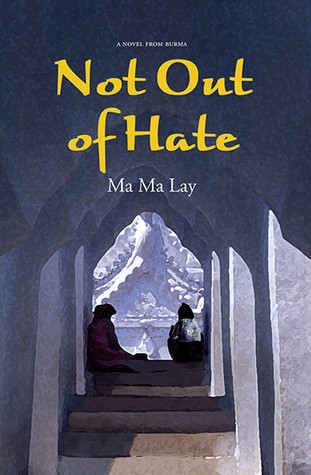
Not Out of Hate by Ma Ma Lay, Translated by Margaret Aung-Thwin

Not Out of Hate
Ma Ma Lay (Ma Tin Hlaing) (1917-1982)
Translated by Margaret Aung-Thwin (Burmese)
Original published 1955; I read 1991 English translation, Silkworm Books 2006 edition
216 pages, psychological, social commentary, love story(?)

Many thanks to Silkworm Books for providing a review copy of this book, and for meeting with me when I visited Chiang Mai, Thailand. 

Trigger warning for discussion of intimate partner abuse.

Way Way is a 17-year-old girl who has been brought up in a traditional Burmese family. Her father runs a rice export business, and her mother left several years ago to become a Buddhist nun. Way Way dearly loves her father and, as the only child left at home when his health takes a turn for the worse, cares for both him and the business.

When a new neighbor arrives, a thoroughly Anglicized Burmese man named U Saw Han, Way Way is struck by his sophistication. She becomes ashamed of the difference between U Saw Han’s English style (of food, furniture, clothing, and so on) and her own rural Burmese style. U Saw Han, in turn, is struck by the contradiction between Way Way’s apparent innocence and childlike behavior and the responsibilities she takes on in the household and business. When they get married, Way Way realizes that his British airs, and his insistence that she also follow them, are not actually what she wants – but at that point there’s no turning back.

Abuse


After their marriage, U Saw Han is thoroughly abusive toward Way Way, although he doesn’t seem to realize it.Out of love” he prevents her from eating the food she likes, wearing clothes that she wants to wear, and even visiting her ailing father. This culminates in refusing to allow her to visit her dying father after she receives an urgent telegram.

Thursday, February 4, 2016

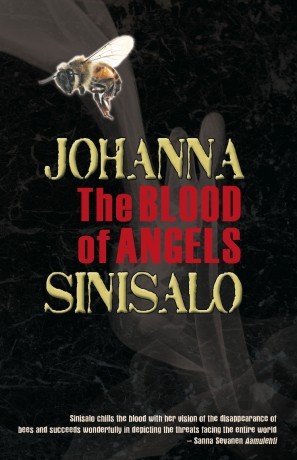
The Blood of Angels by Johanna Sinisalo, translated by Lola Rogers

The Blood of Angels
Johanna Sinisalo
Translated by Lola Rogers (from Finnish)
First published 2011, I read 2014 English translation
224 pages, eco-speculative, grief

Many thanks to Peter Owen Publishers for providing a review copy of this novel. 

In the near future,  Colony Collapse Disorder (CCD), which causes worker honeybees to suddenly vanish from their hives, has become a terrible threat to the human food chain. In the United States, it has caused food shortages and the collapse of the food production infrastructure. When Orvo, a solitary beekeeper in Finland, finds one of his hives empty except for a dead queen, he fears that the catastrophe has finally spread to Finland.

Then he suddenly finds a strange phenomenon: a window to another, uninhabited world. Does this have anything to do with the sudden disappearance of his bees? What about the death of his animal rights activist, teenaged son?

This novel details the beekeeper’s search for answers, interspersed with the posts and comments from his son's blogs.

Thursday, January 28, 2016

Dry Season by Gabriela Babnik, translated by Rawley Grau

Dry Season
Gabriela Babnik
Translated by Rawley Grau (Slovene)
Originally 2012, I read 2015 translation (ebook review copy)
Literary fiction

Many thanks to Istros Books for providing a review copy of this novel! 

Ana, a 62-year-old graphic designer from Slovenia, has run away to a completely foreign place – Burkina Faso. There she meets Ismael, a 27-year-old former street kid with a history of abuse, and they begin a relationship despite – or perhaps because of - their differences. As Ana and Ismael take turns telling us, the readers, about their complex and pain-filled lives, we wander with them further into the dream captivating them.

This novel plays with the stereotypes of the old white woman in Africa as a tourist and the street kid with a history of abuse. Ana and Ismael both are and are not prime examples of their stereotype. Underneath his rough exterior, Ismael thinks deeply and is widely read. He can engage intellectually with the world around him. He isn’t really the fighting, drug dealing street kid that the stereotype would lead you to expect – although he does get involved with those kinds of activities sometimes.

Ana tells us that she chose Burkina Faso because of its complete dissimilarity to where she came from. But the longer she stays, the more she realizes that this new place is not all that foreign after all; she has had similar affairs in the past (with dark-skinned, younger men) and this seems like a repeat all over again. Or did those other affairs actually happen?

Read the rest of my review at Shiny New Books.

Further Reading: 

"Gabriela Babnik" from the European Union Prize for Literature


Want to see more reviews of world literature and film? Follow me on Twitter or like The Globally Curious's facebook page!


Sunday, August 23, 2015

Caged in Paradise and Other Stories by Rizia Rahman, edited by Niaz Zaman and Shirin Hasanat Islam

Caged in Paradise and Other Stories
Edited by Niaz Zaman and Shirin Hasanat Islam
Translated from Bengali
2010
215 pages, short stories, drama, realism, satire

Thank you to UPL for providing a review copy of this book. 

Full Disclosure: I am currently doing an internship with the publisher which includes marketing products including this one. However, the views presented here are my own. 

When I brought up the idea of promoting some literature for Women in Translation Month, my boss's face lit up. "I know the perfect one!" she said, and recommended this short story collection. While paging through the collection to find quotes that we could use for marketing, I found myself being mesmerized by the stories; after skimming the first fifty pages or so, I immediately asked for a review copy. And I was not disappointed - this book, it turns out, is one of my absolute favorite story collections.

Rizia Rahman is a renowned Bangladeshi author. She has been writing short stories and novels since the late 1960s, and received the Bangla Academy Award, the top literary award in the country, in 1978. Before picking up this book, I had never heard of her. Now I'm thinking about buying one of her novels in the original Bengali before I leave the country next month.

The stories in this collection span the length of her career. They deal with personal challenges, community grief, village politics, changing social mores, women's and human rights discussions. Whereas her earlier stories are more straightforward, demonstrating realistic and relatively linear storytelling, her newer ones move toward magical realism and impressionism. All are handled with marvelous skill, providing glimpses of everyday (and not-so-everyday) life in Bangladesh.

Wednesday, July 29, 2015

Sirena Selena by Mayra Santos-Febres, translated by Stephen A. Lytle

Sirena Selena
Mayra Santos-Febres
Translated by Stephen A. Lytle (from Spanish)
First published 2001, I read kindle version
224 pages, LGBT+, drama

Miss Martha Divine, an old veteran of the Drag Queen scene in New York and Puerto Rico, has found her ticket to glory: a 15-year-old with a voice like an angel, who takes on the artist name of Sirena Selena. Miss Martha takes her young protege to the neighboring Dominican Republic, in an attempt to sell the act to one of the fancy tourist hotels there - where they won't mind that the performer is underage.

After seeing Sirena Selena's audition, one very wealthy businessman, Hugo Graubel, is captivated by the young star - in her enchanting performance, he thinks that he has finally found the person that he can love "as I have always wanted to love a woman" (p. 175). Filled with desire, Hugo arranges to have Sirena Selena come to his house, to perform for his business associates at a dinner he will be throwing later that week. His wife, unsatisfied with her husband's continued disinterest in her, is not pleased to have a travesti in the house. Hugo doesn't care what his wife thinks; even if she decides to divorce him over it, he just wants to have Sirena Selena for his very own.

Interspersed with Miss Martha Divine's reminiscences about the gay scene in Puerto Rico and New York and a tangentially related look at the friendship between two young boys, this novel questions the stability of gender, sexuality, and dress in the hot Caribbean world of travestis.

Tuesday, June 2, 2015

The Hen Who Dreamed She Could Fly by Sun-mi Hwang, translated by Kim Chi-Young

The Hen Who Dreamed She Could Fly
Sun-Mi Hwang
Translated by Kim Chi-Young (from Korean)
Illustrated by Nomoco
2000, I read 2013 translation
144 pages, animal fable, motherhood
Found: Starmark, Mani Square Mall, Kolkata

Sprout has always imagined life outside of the confining walls of the egg-laying hut, raising chicks all her own. Depressed, she stops eating, and her eggs stop coming, leading the farmer to take her out to be slaughtered. But she escapes! In time, she becomes friends with an injured wild duck, Straggler, whose partner has been killed by the local weasel. With Straggler's help, Sprout incubates an abandoned egg, which turns out to be the duck couple's baby. When Straggler dies and the egg hatches, Sprout decides to care for this baby as her own - despite the challenges and the ridicule from others caused by their obvious mismatch.

The simply told story narrates Sprout's struggles to raise her baby duck - Greentop, as she calls him - in the inhospitable land outside of the farm's society. Despite the cold winter, deadly weasel, family arguments and other problems, Sprout's competent attitude and motherly perseverance give her the strength to raise Greentop and assert her own identity at the same time.

This is a beautifully told fable about independence, identity, and motherhood. Despite the similarities with children's literature (which have been emphasized by the English-language promotion of the book), Sprout's journey has more to offer people with more life experience. In Korea, it is considered to be an adult novel, and I want to emphasize that aspect.

Tuesday, May 26, 2015

The End of Days by Jenny Erpenbeck, translated by Susan Bernofsky

The End of Days 
Jenny Erpenbeck
Translated by Susan Bernofsky (from German)
2012, I read 2014 ebook version
239 pages, meditation, family, politics, life and death

A baby dies and the family falls apart.
But what if it didn't?
A young woman commits suicide after being rejected in love.
But what if she didn't?
A German emigre to the Soviet Union is accused of Trotskyism and sent to a work camp, where she dies.
But what if she wasn't?
A famous East German writer dies falling down the stairs.
But what if she didn't?
The same woman dies comfortably in a nursing home at the ripe age of 90.

Jenny Erpenbeck's novel traces the life of a woman in Europe during the 20th century, and, specifically, how she could have died at different parts in her life and what the fallout would be for those around her. The author gives us five scenarios, connected by musings on how things could have turned out differently, if, for example, she had gone down the stairs five minutes later. Then, the following section assumes that she had not died, and the alternative scenario is the one that actually happened.

It's sort of like a choose-your-own-adventure book for grown-ups.

In less capable hands, this style of writing could have turned into a terrible gimmick. But Erpenbeck manages to pull it off, all while including some beautiful commentary about the connections between people and the role of history in our lives. While not my favorite book from the IFFP longlist, I can understand why it has such widespread appeal.

Monday, May 4, 2015

The Bronze Sword of Tengphakhri Tehsildar by Indira Goswami, translated by Aruni Kashyap

Source: Goodreads
The Bronze Sword of Tengphakhri Tehsildar
Indira Goswami (1942-2011)
Translated by Aruni Kashyap (from Assamese)
Published by Zubaan 2013
132 pages, folklore, nationalist
Found: Kolkata book fair 2015

This is the last book by the well-regarded Assamese author Indira Goswami, known for her use of literature to advocate for social and political change. Drawing on the idea of a strong female character described in local Bodo folktales, Goswami demonstrates the importance of the Bodo people in the nationalist fight against the British colonialists and therefore in the formation of the Indian nation and the state of Assam (an important political statement due to the continued violence and calls for the creation of Bodoland as a separate state).

Tengphakhri is a tribal Bodo woman who was chosen to act as a Tehsildar, or tax collector, for the British in the late 1850s. Accompanied by her group of soldiers, she rode through the villages to collect taxes, using force if necessary. She has a close relationship with several of her British superiors, who she admires. When other British officers come to take over, leading to changes in policies, she is compelled to choose whether she wants to continue working with them or join the freedom movement.

The description of the character Tengphakhri is interesting. She is obviously a strong person, who can handle horses and do the duties required by her job. Like most women in fiction, "Her beauty and personality mesmerized everyone. They had just one complaint: why doesn't Tengphakhri speak?" She is mostly a silent character, and the story is told through descriptions of her sometimes ambivalent actions.

While this story is based on a folktale, it doesn't read like one. This is a flaw, in my opinion. The mostly emotionless descriptions of Tengphakhri's actions were not interesting to me. I did not enjoy this book for the story or the characters (who were disappointingly flat).

The only thing that seemed interesting to me is the way Goswami tried to use this book to protest against the violence in Assam related to the Bodoland movement. But because that was the purpose of this novel's existence, nationalist sentiments took center stage, stealing the focus from the characters and story. If you are interested in Assamese politics, especially the question of an independent Bodo state, you might find something in this book. If not, it's not really worth your time.

Further reading: 

Wikipedia article on Bodoland 
"Bodoland Movement: A Study" by Topu Choudhury (a scholarly article on the history of the movement) 
"Why is Indira Goswami Great?" by Aruni Kashyap (translator of this novel) 

Follow The Globally Curious on twitter or facebook to see more reviews of international movies and cinema! 


Thursday, April 23, 2015

Sin Is a Puppy That Follows You Home by Balaraba Ramat Yakubu, translated by Aliyu Kamal

Source: Goodreads
Sin Is a Puppy That Follows You Home
Balaraba Ramat Yakubu
Translated by Aliyu Kamal (from Hausa)
Originally 1990, I read first English edition 2012
126 pages, social criticism, family drama, soap opera, pulp

Many thanks to Blaft Publications for providing me with a review copy of this book! 


In this book, I tell a story about a type of man found commonly in Nigeria who regards a married woman with children as a sort of slave to be bought or sold at the marketplace. These men think they may treat such a woman as poorly as they like, since they believe her to be completely worthless. They may be rich and comfortable themselves, yet refuse to feed and clothe their own families - while simultaneously denying anyone else the right to do so. - Author's preface
This short novel is the first example of the Hausa-language popular press to be translated into English. As such, it has the potential to introduce the reader to a world that they otherwise would never have realized existed.

Balaraba Ramat Yakubu is a Nigerian writer and filmmaker. In this book, as she states in the preface, she attempts to draw attention to a specific social phenomenon: men who neglect their wives and children in favor of spending money on themselves. I do not know how common this is in Nigeria, but the author's decision to focus on it indicates that it is (or was) probably more common than I expected.

Sunday, April 12, 2015

Tiger Milk by Stefanie de Velasco, translated by Tim Mohr

Source: Goodreads
Tiger Milk
Stefanie de Velasco
Translated by Tim Mohr (from German)
2014, I read ebook edition
245 pages, friendship, immigrant story, poor families, loyalty, drugs sex and alcohol

Nini and Jameelah, two high school students in Berlin, are the best of friends. They spend their time hanging out, sneakily drinking Tiger Milk (a concoction of brandy, milk, and passion fruit juice that they invented) in public, doing drugs, and making pocket money by prostitution. When they witness a murder in their housing complex, will they risk their own safety and tell the police what they saw? Even if that might mean Jameelah will be deported, one of their friends will be put in prison, and their friendship may very well end?

This is not the kind of book that I normally read, but for the sake of IFFP, I finished it. Some parts made me feel physically sick, especially the way the girls respond to the murder: Jameelah takes the victim's jewelry, dropping it into their container of Tiger Milk, which she then drinks from. (I forgot to mention that they also like shoplifting, which involves wandering through stores with open containers and dropping jewelry into the drink. They don't even keep most of the things they steal.) If Tiger Milk doesn't sound bad enough already, why don't you add some fresh blood to it as well?

I appreciate that this author is attempting to show the edgy side of teenage life among poor people in Berlin. The writing shows the point of view of the characters, and encourages the reader to have some sympathy for the people in the story. If you like that sort of thing, you might like this book.

The author also demonstrates some of the struggles that immigrant families face in present-day Germany. Jameelah and her mom are immigrants from Iraq, and have been in Germany long enough that Jameelah doesn't even know Arabic. And yet they find themselves facing possible deportation back to Iraq if the government finds that they have done something wrong. Obviously this is unfair on Jameelah, who has only ever known what it's like to live in Germany.

Overall, this was my second-least favorite book from the IFFP longlist. It was only surpassed by The Last Lover, which was so bizarre I couldn't even understand what the book was trying to say. I'm glad that Tiger Milk did not make either the shadow panel or the official shortlist. (Read the shadow panel's reviews of all the longlist books here.)

If you're interested in edgy Young Adult books about sex, drugs, alcohol, and murder, you might like this book. If not, avoid it.

You can buy Tiger Milk from Amazon or wherever books are sold. 

Did you like this review? Keep in touch! Follow The Globally Curious on Twitter or Facebook

Sunday, March 29, 2015

The Last Lover by Can Xue, translated by Annelise Finegan

Source: Goodreads
The Last Lover
Can Xue
Translated by Annelise Finegan (from Chinese)
2014, I read Kindle edition
336 pages, avant-garde (?)

This book traces the (possibly) intersecting lives and stories of a group of people who are related through work: a man who just wants to disappear into books, his maybe-magical wife, his gardener son; his cheating boss and his boss's distraught wife; a client who owns a rubber plantation and his lover, and so on. As the book goes on, their stories become more and more confused and begin to run together until everything seems unreal.

I did not understand or like this book, and I was surprised that it was nominated for the 2015 IFFP. According to the Goodreads ratings and the opinions of the other Shadow Panelists, it seems that people either really like this book or they really don't. I would be one of the latter. I kept expecting someone to wake up and have the whole thing be a complicated dream, but no such luck. I was just as confused after reading the whole thing as I was at the beginning. I get that this is (probably?) the point, but it's not something that I enjoy.


Something that bothered me was the weird Orientalism present throughout the book. While the main characters are all from some unnamed Western country, the knowledge that they hope to find comes from the East. This includes the ending when all (?) of the characters wind up traveling throughout the East looking for some sort of knowledge (?). There is also a strange woman who apparently sleeps with all (?) the male characters and who is apparently from some sort of Oriental country. I was surprised to see this weird Orientalism in a Chinese novel. Maybe it's satirical? Since I didn't understand the book, maybe I also didn't understand the satire? It would be great if someone could explain it to me.

All and all, something that you might like if you're interested in really dreamy, avant-garde, far out stuff. Not something I am interested in at all. But one of the other Shadow Panelists mentioned that the author's short stories are good, so maybe I'll see if I like those better at some point.

Further Reading


An interview with Can Xue from Asymptote Journal 

The Last Lover can be purchased from Amazon or wherever books are sold. A sample is available from Amazon here

Want to see more reviews from The Globally Curious? Follow me on twitter or facebook to see the latest updates! 

Tuesday, March 24, 2015

The Giraffe's Neck by Judith Schalansky, translated by Shaun Whiteside

The Giraffe's Neck
Judith Schalansky
Translated by Shaun Whiteside (from German)
2014 Bloomsbury
211 pages, satire, science

In this darkly humorous book, an old-school (East German) biology teacher analyzes everything in terms of Darwin's theory of evolution. Despite the diminishing number of students and the new educational plans, she remains stolidly in her lifelong habits of inducing fear and respect in class.

How will Frau Lomark survive in a changing world?

This book is described as a Bildungsroman, a novel dealing with character formation, formal education, or a coming-of-age story. (Thanks to Stu at Winstonsdad's blog for pointing out the importance of this term in his review of The Ravens.) However, I have some doubts about the applicability of that term to this story.


Tuesday, January 13, 2015

The Master Key by Masako Togawa, translated by Simon Grove

Source: Goodreads
The Master Key
Masako Togawa
Translated by Simon Grove (from Japanese)
Originally 1962, I read 1986
160 pages, thiller, mystery

In postwar Japan, a never-before-seen engineering feat will move a ladies' dormitory to make way for a new road - so smoothly, the head of the project assures the elderly inhabitants, that they won't even spill a drop of water from a glass.

As the women, retired spinsters and widows who have shared the same living spaces for decades, stare at the full glasses poised on their tables, a tangle of mysteries and secrets will be revealed. Seven years ago there was a secret burial underneath the building, of a suitcase that was just child-sized.

But that is not the only secret that has haunted the residents of the dormitory in recent months. The master key, the only key that will open every door in the building, has gone missing. And someone seems to be discovering secrets that have been hidden for a long time....

Buy from Amazon: 

The Master Key (King Penguin)

Thursday, January 8, 2015

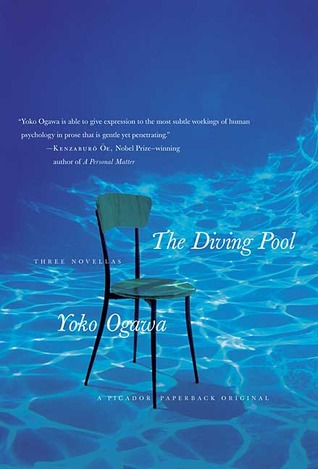
The Diving Pool: Three Novellas by Yoko Ogawa, translated by Stephen Snyder

Source: Goodreads
The Diving Pool: Three Novellas
Yoko Ogawa
Translated by Stephen Snyder (from Japanese)
Originally 1990, I read 2008
164 pages, suspense, horror

This collection of three novellas by Yoko Ogawa touch on different emotions.

"The Diving Pool" tells the story of the frustrated protagonist, the only non-orphan living in her parents' orphanage. She has fallen in love with one of the foster children, a boy who has been in the orphanage for about a decade, and especially with his athletic body when he practices diving. But she feels unable to tell him about her infatuation, and her repressed feelings lead her to be cruel to one of the other orphans.

"Pregnancy Diary" describes the evolution of the narrator's sister's pregnancy. The narrator is confused - her sister does not seem to be very interested in her child, she does not seem to be getting much bigger, and she refuses to talk about it. The narrator tries to help as much as possible, but what exactly is going on?

"Dormitory" recounts the story of a young married woman returning to her college dormitory with her cousin. She reignites her acquaintance with the one-limbed manager of the building, whose health has deteriorated since her time there. But then she hears about the disappearance of a student from the building a few months ago, and she hasn't seen her cousin recently, and what is that buzzing sound?

Read a sample or buy on Amazon:
The Diving Pool: Three Novellas

Saturday, January 3, 2015

Baba Yaga Laid an Egg by Dubravka Ugresic, translated by Ellen Elias-Bursac, Celia Hawkesworth, and Mark Thompson

Source: Goodreads
Baba Yaga Laid an Egg
Dubravka Ugresic
Translated by Ellen Elias-Bursać, Celia Hawkesworth, and Mark Thompson (from Croatian)
Originally 2007, I read 2009
327 pages, folklore, post-modern

This post-modern take on the folklore character of Baba Yaga contains three sections that may or may not be connected to each other:

A tale of an author's* relationship with her cleanliness-obsessed, dementia afflicted mother. At her mother's urging, the author undertakes a trip to their hometown with a recent-Ph.D. in folklore.

The author's* novella about three elderly female friends who travel abroad to a health spa.

A folklore scholar's description of the Baba Yaga stories and remarks about how the first two sections (presented as a book manuscript from an editor) relate to those folktales.

*"The author" here refers to the character in the novel. I will specify Ugresic by name to avoid confusion. 

Read a sample or buy from Amazon:
Baba Yaga Laid an Egg

Friday, January 2, 2015

Like Water for Chocolate by Laura Esquivel, translated by Carol Christensen and Thomas Christensen

Source: Goodreads
Like Water for Chocolate
A Novel in Monthly Installments with Recipes, Romances, and Home Remedies
Laura Esquivel
Translated by Carol Christensen and Thomas Christensen (from Spanish)
Originally 1989, I read 1994
241 pages, magical realism, romance

Tita enters the world on a wave of tears, prophetic of the difficult life ahead of her. Tita's mother, the narcissistic, overbearing matriarch of the family, bans her from marrying; as the youngest daughter, she is required to take care of her mother until death. When her eldest sister marries Tita's beloved, Tita retires to the kitchen, using food to express her barely-restrained emotions.

A beautiful example of magical realism, Like Water for Chocolate combines the real magic of good food and romance with the tall tales of family legends.

Read a sample or buy from Amazon:
Like Water for Chocolate: A Novel in Monthly Installments with Recipes, Romances, and Home Remedies


Friday, December 26, 2014

A Concise Chinese-English Dictionary for Lovers by Xiaolu Guo

Source: Goodreads
A Concise Chinese-English Dictionary for Lovers
Xiaolu Guo
Originally 2007, I read 2008
283 pages, romance, psychological

A young Chinese woman from a peasant background moves to London to study English for a year. Shortly after arriving, she meets a British man who is 20 years older than her, falls in love with him, and moves into his house.

In this novel, written in progressively better English, she recounts events from her English life as they relate to both her own personal development and her relationship with her lover, to whom the writing is addressed. Love and isolation and frustration and culture shock intermingle in this unhesitatingly truthful, intimate story.

Read a sample: 


Buy from Amazon: 

A Concise Chinese-English Dictionary for Lovers


Saturday, December 6, 2014

I Am Istanbul (Istanbullu) by Buket Uzuner, Translated by Kenneth J. Dakan

Source: Everest Yayinlari
I Am Istanbul (Istanbullu)
Buket Uzuner
Translated by Kenneth J. Dakan (from Turkish)
Originally 2007, I read Everest Publication's 2008 version
421 pages, drama

The Airport: Land of Arrivals and Departures

Ataturk International Airport in Istanbul. On this day, as on any other day, it is crowded with people: people waiting for passport control, people running to catch their plane, people checking their makeup in the bathroom, people gazing at the arrivals board, people shopping for last-minute duty-free Turkish Delight. Airport staff greet them, direct them, flush toilets when they forget. On this absolutely normal day, a couple is about to be reunited and start a new life together: Ayhan, a Kurdish sculptor, and Belgin, a professor of genetics formerly based in New York. Are they ready for this tremendous change? And are they ready for what the airport will throw at them in the next few hours?

This novel explores the thoughts, feelings, and impressions of a wide range of Istanbullu who are only united by their common, anonymous presence in the airport at the same time. Can they find common ground in a moment of crisis?

Read a sample

Buy from Amazon:

I Am Istanbul

Tuesday, November 25, 2014

The Adventures of Misfit Defne Kaman: Water by Buket Uzuner, Translated by Clare Frost and Alexander Dawe

Source: Everest Yayinlari
The Adventures of Misfit Defne Kaman: Water
by Buket Uzuner
Translated by Clare Frost and Alexander Dawe (from Turkish)
Originally published 2012, English edition 2014
376 pages, feminist fantasy, mystery

A Mystery Unfolding...


The police Sergeant Ümit Kaman is just counting down the minutes until his vacation and a chance to escape from the summer heat of the city when a missing person report draws him into a strange world in which anything is possible. The journalist Defne Kaman has disappeared, seemingly into thin air - many people watched her step onto a ferry, but no one saw her step off! Her mother and sister reassure the Sergeant that she disappears like this all the time, but her charismatic grandmother seems worried. She also seems to know more about the Sergeant than she has any right to know... such as his 2-year-old heartbreak over being separated from the woman he loves...

The plot thickens when the missing journalist appears before the Sergeant in a crowded street, silent and soaking wet, and thrusts a piece of paper into his hands before vanishing again. The paper is covered with codes... codes that might match the couplets of an ancient piece of Proto-Turkish literature that the Sergeant's friend Secondhand Semahat adores.... And then there is the dolphin that's acting strangely, and Defne's grandmother's strange influence - it can't just be charisma, can it?