Showing posts with label Bengali. Show all posts

Monday, October 24, 2016

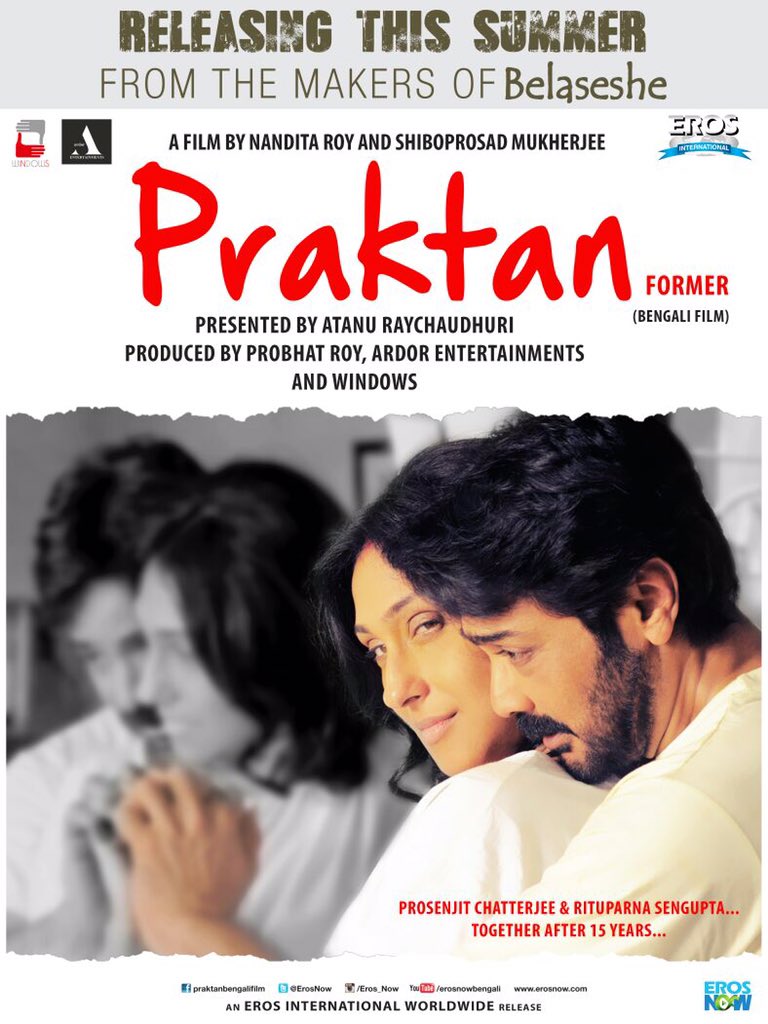
Praktan, directed by Nandita Roy and Shiboprosad Mukherjee

Praktan
India (Bengali), 2016
143 min, drama
Directed by Nandita Roy and Shiboprosad Mukherjee
Starring Rituparna Sengupta, Aparajita Auddy, and Prosenjit Chatterjee

Content Warning: Discussion of Emotional and Physical Abuse

Ten years ago, Sudipa and Ujaan divorced after a difficult marriage. Today, Sudipa finds herself in a first-class train carriage from Mumbai to Kolkata with Malini, Ujaan’s new wife, and their daughter. During the course of the two-night train journey, Sudipa finally deals with the pain from years before.

Meanwhile, we see the stories of people in other rooms in the same carriage. Four famous Bengali musicians (Surojit Chatterjee, Anindya Chatterjee, Upal Sengupta, and Anupam Roy, playing themselves) serenade each other with new compositions. An elderly couple returns from Mumbai after seeing their son off to the US. And last but not least, a couple of newlyweds put the trip in a private cabin to good use.

Both an intimate story of pain, heartbreak, and healing, and a glance at the things that happen in first class, this is a new, great train movie from West Bengal. However, the ending left a bad taste in my mouth.

Sunday, July 10, 2016

Ontorjatra, directed by Tareque and Catherine Masud

Ontorjatra
Bangladesh (Bengali and English), 2006
84 min, slice-of-life, drama
Directed by Tareque and Catherine Masud
Starring Sara Zaker and Rifakat Rashid

After 15 years abroad, Shireen and her son Sohel return to Bangladesh to attend the memorial service for Sohel’s father. After getting a divorce when Sohel was five years old, Shireen had fled to the UK and cut off any communication with her ex-husband. This included allowing Sohel to visit Bangladesh or communicate with his father in any way.

Bangladesh is not like Shireen remembers, and Sohel is experiencing it for the first time. As Sohel discovers the family that he never knew, Shireen is forced to confront her past and the decisions she made all those years before.

This is a major, well-known Bangladeshi movie. I wouldn’t call it a good movie, necessarily: the acting, in particular, leaves a lot to be desired, and there are far too many voiceovers. However, it does a very good job of showing what life in Bangladesh is actually like – and that is what I want to focus on.


Dhaka


I have told my husband many stories about Dhaka and Bangladesh, but he’s never been there. I was surprised when he started exclaiming about things that he noticed in this film. “The airport is so 1970s!” “The buses are so beat up, they look terrible!” “God, this is what the traffic really looks like???” I guess my descriptions didn’t convey as much as this video did.

This movie gives a good sense of what it feels like to be walking around in Bangladesh and interacting with Bangladeshi people there. Dhaka is full of too many people, too much traffic and too much pollution, and it’s constructed out of new high-rise buildings, with older buildings few and far between. But if you go outside of Dhaka, the countryside is beautiful – green rice fields stretching into the distance and the tea gardens in Sylhet.


Read the rest at The Asian Cinema Blog


Want to see more reviews of world literature and film? Follow me on Twitter or like The Globally Curious's facebook page!

Sunday, June 12, 2016

Cinemawala by Kaushik Ganguly

Cinemawala
India (Bengali), 2016
105 min, drama, dysfunctional family
Directed by Kaushik Ganguly
Starring Paran Banerjee, Parambrata Chatterjee, and Sohini Sarkar

Pranabendu Das was the proud owner of a single-screen theater in one of the rural suburbs of Kolkata until it went out of business upon the advent of digitalization. Now, with his trusty employee Hori, Pranabendu constantly laments the downfall of old-style theater and his son Prokash’s abhorrent trade of selling pirated DVDs.

Now Pranabendu and Prokash barely speak to each other, and Prokash’s wife Moumita is stuck in the middle. When Prokash gets a brilliant idea to make more money illegally, how will his principled father react?

I saw this movie in a traditional single-screen theater in Kolkata with Tintin and his 80-year-old aunt. This was the perfect place to see this movie, both because of the theme and because some of the shots of the theater in the film lined up perfectly with the seating arrangement in front of us. However, I found little to like in the film itself.

The Ultimate Dysfunctional Family


If you like depressing movies about incredibly dysfunctional families, this one might be up your alley. Prokash and Pranabendu hate each other. They never speak to each other, despite living in the same house. Prokash is resentful about having to provide food for his aged father, especially because his father hates how he makes the money. He also thinks his father is stupid because he did not upgrade the theater as Prokash recommended and considers it his father’s fault that he had to take up selling pirated DVDs.

Pranabendu not only hates his son, but also gets drunk every night and reminisces about the glory days of the theater. He is definitely out of touch with reality, and this has apparently caused his wife, Prokash’s mother, to abandon him and move to Kolkata. Prokash’s mother is currently taking care of her own father, who is senile and partially paralyzed because of a stroke. Prokash apparently only visits his mother when there is some big news; otherwise, she never hears from him.

And then there is Moumita, Prokash’s wife, who takes good care of her father-in-law. They have a good relationship, but it is constantly sabotaged by the ongoing row between the father and son.

Piracy and Paying the Creators


One good thing that this movie does is point out the problems with piracy. Not only is Prokash doing something illegal but, as his dad points out, it also takes away any profit that the creators may have received. This is an important message in India today, where piracy, plagiarism, and other kinds of intellectual theft are commonplace.

I did not see anything likable about this movie, but if the description I have given above seems attractive, go ahead and watch it. And, just out of curiosity, I would be interested in hearing your opinion of the film.

Further Reading: 


"10 Awesome Single Screen Cinema Halls of Calcutta" from The Calcutta Girl
"Fading Lights" by Subhro Niyogi from The Times of India (2011)

Want to see more reviews of world literature and film? Follow me on Twitter or like The Globally Curious's facebook page!

Tuesday, February 2, 2016

Byomkesh Bakshi directed by Anjan Dutt

Byomkesh Bakshi
India (2015), Bengali
110 minutes, detective, mystery
Directed by Anjan Dutt
Starring Jisshu Sengupta and Saswata Chatterjee

An elderly mine owner asks the famous detective Byomkesh Bakshi to solve a case for him: someone attacked and almost killed a labor leader in his mine, and he is afraid that there is a plot to ruin his business. When Byomkesh and his assistant arrive in the mining town incognito as guests of their client, they discover that there has been a murder carried out in an almost identical way to the attack on the labor leader – and one of the prime suspects is their client’s adult son.

This is a solid detective movie, based on one of the most popular Bengali detective characters (of which the most famous is Satyajit Ray’s Feluda). It was my first introduction to Byomkesh, and I quite enjoyed the character. One thing that most appreciated is that he wears a dhoti, the old-fashioned Bengali Hindu garment, rather than pants, which are more common and considered more professional. When other characters look down on him for being old-fashioned, he just smiles and takes advantage of their disdain. It is quite refreshing to see the dhoti's current meaning subverted in this way.

The women in this movie have prominent roles, even though they are mostly depicted protecting their men. The mine owner’s daughter-in-law, for example, is smart and knows who Byomkesh is, even though he has arrived under a pseudonym. She approaches the detective for help determining whether her husband is guilty of murder. She does not do this because she wants Byomkesh to help him get out of trouble; no, she is terrified that her husband is a murderer and she wants Byomkesh to find out the truth so she can decide on her next step.  This is not a passive woman begging for help to clear her husband's name, but a woman who has found herself in a bad situation and who wants more information before deciding what to do about it.

I won’t say any more because of spoilers, but I recommend that you watch this movie if you like detective fiction. The 1960s setting captures the feel of the original stories, resulting in both a solid detective movie and a good introduction to one of Bengal’s famous fictional detectives.


Further Reading: 


"Byomkesh, Feluda and Kakababu" by Avik Kumar, a good introduction to Bengali literature's three major detectives
"Sharadindu Bandyopadhyay" from Wikipedia (the author of the Byomkesh stories)


Want to see more reviews of world literature and film? Follow me on Twitter or like The Globally Curious's facebook page!


Sunday, December 27, 2015

Uttarer Sur (The Northern Symphony), directed by Shahnewaz Kakoli

Uttarer Sur (The Northern Symphony)
Bangladesh (Bengali), 2012
113 min, drama, social commentary
Directed by Shahnewaz Kakoli

Chan Miya is a traditional folk musician who plays the dotara, a stringed instrument, and performs songs from the "Bhawaiya" tradition of Northern Bangladesh. He lives in a rural village with his wife Ambia and their daughter Ayesha, who is learning to perform as well. While the amount of money he earns from playing his music in train stations and markets is quickly diminishing, he has pride in his art and is hesitant to take up the more lucrative manual labor that is available in the village. Chan Miya dotes on his daughter and finds it difficult to refuse any of her requests - even when she wants to buy pet pigeons with the little bit of money they have for food.

Ambia, an orphan with skin that is considered far too dark, comes from an abusive background. The lack of food and her societal role as the artist's wife is taking a toll on her, and she is angry with her husband and daughter when they spend their tiny income on frivolities. She wishes she could go to work herself, but it would be a shame for the family if people know that Chan Miya is unable to provide for them through his art.

While this movie has some major flaws, I have chosen to review it because it depicts the difficulties faced by traditional musicians in a rapidly changing part of rural Bangladesh.


Monday, November 23, 2015

Jamai Babu, directed by Kalipada Das

Jamai Babu
British India (silent with English, Bengali, and Hindi titles), 1931
23 min, slapstick comedy
Directed by and starring Kalipada Das

In this Charlie Chaplin-inspired silent film made in Calcutta, the country bumpkin Gobardhan arrives in the city, is confused by the traffic and noise, believes that a “no nuisance” sign is an address, and fakes illness to spend more time at his in-laws' house so he can sleep with his wife. This is the only surviving Bengali silent film, accidentally rediscovered by Mrinal Sen’s film crew while shooting on location in 1980.

Three versions


One of the most interesting things about this film is the multilingual titles. Like all silent movies, this one has title slides interspersed with the filmed sequences to provide context, narration and dialogue. But because of the multilingual milieu in which it was made, Jamai Babu has titles in three languages - English, Bengali, and Hindi – and they say slightly different things! This provides an interesting opportunity to analyze a film that was originally made in three different languages.

For example, at 4:44, the English-language titles say "What's this Amulda- are you not taking me with you?" but the Bengali titles say "What's this Amulda - you're leaving, are you not going to show me the city?" I don't know Hindi, but I expect that the Hindi version also says something slightly different. This difference is important because the next title screen contains the reply, in which Amulda says that he will show Gobardhan the city later. In the English version, this is a somewhat confusing reply, since the tour has not been mentioned before; in the Bengali version, however, it makes complete sense. Comparing the English and Bengali versions throughout the film, the Bengali version usually provides more context and humor, whereas the English one sounds overly formal and simplified.

When this film was first made, how did multilingual people negotiate these titles? Did they ignore all but one language, or read two or three and combine them to make a composite story? I have no idea, but it would be fascinating to find out.

Wednesday, September 23, 2015

Ghetuputro Komola (Pleasure Boy Komola) directed by Humayun Ahmed

Ghetuputro Komola (Pleasure Boy Komola)
Bangladesh (Bangla), 2012
101 min, historical drama, LGBT+, psychological, musical
Directed by Humayun Ahmed

In colonial-era Bengal, a Muslim zamindar (landowner) hires a musical group to entertain him during the monsoon, when flooding makes it difficult to travel or work. The group performs in the "Ghetu" musical tradition, which combined folk music and dancing with a special performance by young boys dressed as women. Zamindars hired "ghetu" groups for both the musical diversion they could provide and the sexual services of the "ghetu" boys.

In this case, Jafir, who goes by the "ghetu" name Komola, arrives with his father (the head of the troupe) and other musicians. Despite their class differences, he makes friends with the zamindar's daughter, who is about the same age as him. But the zamindar's wife hates Jafir for stealing her husband's affections. In this complicated domestic situation, Komola/Jafir must do her/his job, and make enough money to keep his family fed for the foreseeable future.

This is the last movie made by noted Bangladeshi author and filmmaker Humayun Ahmed, and it was the official Bangladeshi nomination for the Foreign Language Oscar at the 85th Academy Awards.


Sunday, August 23, 2015

Caged in Paradise and Other Stories by Rizia Rahman, edited by Niaz Zaman and Shirin Hasanat Islam

Caged in Paradise and Other Stories
Edited by Niaz Zaman and Shirin Hasanat Islam
Translated from Bengali
2010
215 pages, short stories, drama, realism, satire

Thank you to UPL for providing a review copy of this book. 

Full Disclosure: I am currently doing an internship with the publisher which includes marketing products including this one. However, the views presented here are my own. 

When I brought up the idea of promoting some literature for Women in Translation Month, my boss's face lit up. "I know the perfect one!" she said, and recommended this short story collection. While paging through the collection to find quotes that we could use for marketing, I found myself being mesmerized by the stories; after skimming the first fifty pages or so, I immediately asked for a review copy. And I was not disappointed - this book, it turns out, is one of my absolute favorite story collections.

Rizia Rahman is a renowned Bangladeshi author. She has been writing short stories and novels since the late 1960s, and received the Bangla Academy Award, the top literary award in the country, in 1978. Before picking up this book, I had never heard of her. Now I'm thinking about buying one of her novels in the original Bengali before I leave the country next month.

The stories in this collection span the length of her career. They deal with personal challenges, community grief, village politics, changing social mores, women's and human rights discussions. Whereas her earlier stories are more straightforward, demonstrating realistic and relatively linear storytelling, her newer ones move toward magical realism and impressionism. All are handled with marvelous skill, providing glimpses of everyday (and not-so-everyday) life in Bangladesh.

Thursday, May 28, 2015

INTERVIEW: Suman Ghosh on his film Kadambari


Suman Ghosh is both a director of crossover Bengali-language films and a professor of economics at Florida Atlantic University. His previous films include Footsteps (2006), Dwando (2009), Nobel Chor (2011), and Shyamal Uncle Turns Off the Lights (2012).

After seeing his newest film Kadambari (read my review here), I wanted to know more about how the film was made. He graciously accepted my request for an interview, so it is my great pleasure to present some behind-the-scenes information on this brilliant film!

Lightly edited for clarity. 

First, I wanted to thank you for making this movie. Was it considered controversial when you first proposed it?
A film which features Rabindranath Tagore will be controversial to begin with. And also the fact that the film focuses on an episode which is sensational adds to the controversy. But somehow that did not bother me too much since I was quite clear as to how I want to present the film.

Wednesday, May 20, 2015

Kadambari directed by Suman Ghosh

Kadambari
India (Bengali), 2015
90 min, biopic, history, period drama
Directed by Suman Ghosh
Starring Konkana Sen Sharma and Parambrata Chattopadhyay 

Read my exclusive interview with the director, Suman Ghosh

In 1868, the ten year old Kadambari was married into the famous Tagore household of North Kolkata, a wealthy, learned, progressive family at the forefront of Bengali society. Her husband, Jyotindranath Tagore, is nine years older than her; with no friends her age, she has a hard time acculturating to her strange new life in the Tagore household. That is, until she begins to play with Robi, as the then-8-year-old future Nobel Prize Laureate for Literature Rabindranath Tagore is called.

Growing up together, Kadambari and Robi become close confidants. She is highly educated, and provides critiques and encouragement that stimulate Robi's budding interest in poetry. Over time, Kadambari's already-distant relationship with her husband becomes more strained, especially after hearing rumors of her husband's affairs. Having never quite felt like a part of the family, she finds herself even more isolated from the other women after the accidental death of a niece while in her care.

All of this comes to a head when the family learns about speculation that Robi and Kadambari's relationship is more than brother-and-sister-in-law. While it is unclear whether their friendship actually flourished into a romance, it seems that Kadambari did have feelings for her brother-in-law. Their scandalized relatives hurriedly arrange Robi's wedding, driving a wedge between Kadambari and her last source of emotional support. This proves to be too much when she finally obtains proof of her husband's extramarital activities.

Kadambari committed suicide in 1884, four months after Rabindranath's wedding. In order to prevent further scandal, the family covered up the suicide, saying that she died of natural causes. For this reason, it has been very difficult to find concrete information about how and why she died.

In this biopic on Kadambari's life, director Suman Ghosh finally has the opportunity to explore the events leading up to her death. Using established facts and historical sources (especially Rabindranath's writings), he has created a tight narrative that hints at what may have been without sensationalizing the possibilities. The result is a beautiful glimpse of the occasionally satisfying, more often frustrating life of a woman married into the first family of Bengali society during the Bengali Renaissance.


Friday, May 15, 2015

Harano Sur directed by Ajay Kar

Harano Sur (The Lost Melody)
India (Bengali), 1957
162 min, romance, drama, amnesia
Directed by Ajay Kar
Starring Uttam Kumar and Suchitra Sen

Rama, a female psychiatrist at a mental institution, quits her job in protest of an older doctor's treatment of Alok, a patient who has lost his memories after a train accident. When Alok tries to escape from the hospital and takes shelter in Rama's institution housing, she decides to take him with her to her village. Having been trained in a newer form of psychiatry, she knows that Alok will not improve under treatment by the doctors at the hospital, and that she is the only one who knows how to treat him properly.

As Alok settles in with Rama and her father, he improves thanks to Rama's expert treatment and the countryside environment. In time, Rama falls in love with him and they are married with her father's blessings. While Alok tries to apply for jobs, Rama makes a bit of money working as an ordinary physician for the villagers. One day, on his way to mail an application, Alok has another accident which returns his previous memories, while making him forget all about the last few months at the hospital and his time with Rama. Confused by his situation, he returns to Calcutta and his old life as a wealthy businessman.

Rama follows him to Calcutta, and after wandering through the streets for days serendipitously sees him entering his office building. After a brief meeting, she takes up a position as his niece's governess. Alok has no memory of her at all, but she hopes that, by staying near to him, she can jog his memory. But then she discovers that he has a fiancee, Lata, who is suspicious of Rama's intentions. Will Alok's memories return in time? Or will Rama be humiliated and sent home in shame?

Harano Sur is a famous Bengali movie from the Golden Age of Bengali cinema. It stars one of the favorite screen couples of that era, Uttam Kumar and Suchitra Sen, as Alok and Rama. But how does it hold up 60 years later?


Thursday, May 7, 2015

Nirbaak directed by Srijit Mukherji

Source: Wikipedia
Nirbaak (Speechless) 
India (Bengali) 2015
107 minutes, drama, love story, quirky, fantasy elements
Directed by Srijit Mukherji
Starring Anjan Dutt, Jishu Sengupta, Ritwick Chakraborty, Sushmita Sen

A man who loves himself a little too much. The erotic fantasies of a tree in a park. A golden retriever who doesn't approve of her owner's fiancee. The overseer of a hospital morgue's overactive imagination from watching too many Hindi films.

In this non-linear, meditative reflection on life, love, and loneliness, each of these everyday stories feature one silent and one active character. Each asks how to cope with the loneliness of life. And all are connected, however loosely, through the participation (however minimal) of one woman who is doomed to die.

Through brilliant physical acting and the creative use of camera angles and techniques, Srijit Mukherji brings these at times creepy, at times quirky narratives to life.


Wednesday, March 18, 2015

Mosquito and Other Stories by Premendra Mitra, translated by Amlan Das Gupta

Source: Goodreads
Mosquito and Other Stories:
Ghana-da's Tall Tales
Premendra Mitra
Translated by Amlan Das Gupta (from Bangla)
Penguin Modern Classics, 2004; I read paperback version
170 pages, science fiction, adventure, satire, tall tales
Found: second hand at the Kolkata Book Fair 2015

"Yes, I once killed a mosquito." 
We were astounded - not because Ghana-da wouldn't let even mosquitos alone, but at his unbelievable modesty. If mosquitos had to be killed at all, how could it be that Ghana-da had killed just one?  
Shishir summoned up his courage and asked, "You killed one mosquito?"
"Yes, I've killed only one mosquito in my whole life," Ghana da said leaving us speechless, and that was on the Sakhalin island, on the fifth of August, 1939! 

Ghana-da is a resident of a boarding house in Kolkata, but his history is much more exciting if you listen to him. Whenever the residents engage in adda, the Bengali art of having conversation for hours, Ghana-da is the main attraction. Sitting in his reserved comfy armchair, "borrowing" yet another cigarette, Ghana-da spins tales that are taller than tall, that can't be real - except, if they didn't happen, then how does he know all these details?

His tales encompass fantastic geographic descriptions, adventure stories, thousands of languages, mad scientists, and other exciting characters, both friend and foe. This volume is a collection of 12 short stories from Premendra Mitra's Ghana-da series.

Sunday, November 2, 2014

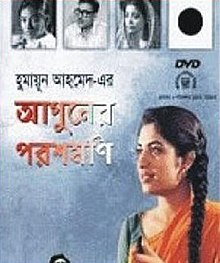
Aguner Poroshmoni directed by Humayun Ahmed

Source: Wikipedia
Aguner Poroshmoni
Bangladesh (Bengali), 1995
123 min, war
Director: Humayun Ahmed
Aguner Poroshmoni (1995) on IMDb


The first film directed by the late Humayun Ahmed, a famous Bangladeshi novelist and director.

Caught in the middle of a genocide, one family struggles to survive


1971, East Pakistan: the Bengali guerilla fighters of the Mukti Bahini are engaged in a life-or-death struggle with the Pakistani army. In what was later termed a genocide, the Pakistani military had launched an operation to suppress the Bengali nationalist movement in May 1971. They targeted intellectuals, civilians, students, and activists, brutally murdering them and burying them in mass graves. Many women were captured and used as sex slaves by the soldiers. When the Bengali people realized what was happening, many fled to take refuge in India. Some returned with weapons as part of the Mukti Bahini, using acts of terrorism and guerilla warfare to counter the overwhelming Pakistani force. This struggle ended by the end of the year, with the result of Bangladesh gaining independence from Pakistan. The war, then, is called the Bangladesh Liberation War.

In the midst of this terrible situation, one family in Dhaka is trying to live life as normally as possible. But then the father brings home a man, a stranger that the family has never met before. They soon discover that he's a member of the Mukti Bahini. They must decide whether to help him and endanger themselves, or to make him leave and probably be killed. 

The full film (without English subtitles, unfortunately) on Youtube: