Dangal
India (Hindi), 2016
161 min, sports movie, biography
Directed by Nitesh Tiwari
Starring Aamir Khan, Fatima Sana Sheikh/Zaira Wasim, Sanya Malhotra/Suhani Bhatnagar
After he is forced by financial circumstances to give up his own wrestling career, Mahavir Singh Phogat plans to train his future son(s) so that they will win a gold medal for India on the international stage. When he ends up having four daughters, he thinks his dream is lost – but then he has the radical idea that girls can be wrestlers, too. After many years of intense training, he manages to bring two of his daughters, Geeta and Babita, to the international level. But will his old-fashioned, village methods work against athletes from around the world?
This movie tells the true story of Geeta Phogat, the first Indian woman wrestler to win a gold medal at the Commonwealth games (in 2010), her sister Babita Kumari, also a gold medalist, and their father who coached them to greatness.
The Cultural Context
This film does a good job of showing the cultural context and why, exactly, this family is so remarkable. Mahavir and his family live in a village in rural Haryana, India – a state known for its poor treatment of girls, and high rates of female infanticide. Haryana has one of the worst sex ratios of any Indian state: 861 women for every 1000 men in the whole population, and 835 girls for every 1000 boys aged 0-6 years. Patriarchy, especially the wish for male children to carry on one’s legacy, is particularly strong. The movie demonstrates this cultural pressure for male heirs through a humorous sequence, in which Mahavir receives innumerable bits of advice on how to conceive a male child. In the end, it seems to be a catastrophe for the entire village when all of these efforts fail and Mahavir’s wife continues to have girls.
When Rani’s fiancée breaks up with her two days before their wedding, she decides to go on the honeymoon by herself. Her first time outside the country, and her first time really alone, gives her the opportunity to explore who she is and what she wants from life.
While in many ways this film draws upon problematic stereotypes of “life in the West,” it still provides a good example of a sheltered young woman steering her own life for the first time.
Self-exploration
In Delhi, Rani lives a sheltered and protected life. Her younger brother acts as her chaperone, especially when she meets Vijay, her fiancée. It seems like her match with Vijay was only partially of her own accord: she wanted an arranged marriage, and this marriage seems to be half-arranged. I’m not sure she really considered any alternatives before making the decision, since she just took marriage as a matter of course.
When Vijay dumps her, she is devastated. She curls up in a ball and cries in her room for a whole day. But she emerges with a decision: she was really looking forward to going to Paris, and had even spent all of her life savings on the ticket – so she wants to go. At this point, she still gives her parents the veto decision, but her father realizes that she needs to do this for herself. Hesitantly, they drive her to the airport and send her on an adventure without them.
At first Rani is incredibly overwhelmed, lonely, and just wants to go home, but then she makes friends and begins to enjoy herself. As she does so, she realizes that she doesn’t need a man to have fun or to travel. She also realizes that some of the assumptions she was making about other people were wrong. For example, although she has been taught that all men are scary, she ends up befriending her three male roommates at a hostel in Amsterdam. Over the course of the film, as she continues to try new things, she becomes less afraid and more independent.
The Indian jerk boyfriend
This film directly addresses one of my pet peeves about Indian movies: the valorization of abusive (even stalker!) boyfriends. After Vijay dumps her suddenly, with no thought about her feelings, Rani accidentally sends him a picture. Seeing this selfie, Vijay suddenly realizes that he actually still loves her. He begins calling her repeatedly, and even goes to Paris and then Amsterdam to track her down.
At first, Rani doesn’t know what to do about this. She is angry, but society has taught her that she should forgive him. When he suddenly appears in Amsterdam, she is willing to talk to him privately - even after he tries to beat up one of her new friends in a fit of over-possessive stupidity! Finally, at the end of the film she realizes that his behavior is not acceptable and that he does not deserve her.
My biggest problem with this film is the incredibly stereotypical depiction of the West. As usual, Rani’s character exploration is accompanied by large amounts of drinking, clubbing, and visiting red light areas (in Amsterdam, of course). Like other films of this genre, it seems like the only way Rani can loosen up is by literally wearing less clothes and drinking. Obviously, this isn’t all that happens in the West – but if you watch Indian movies you would be forgiven for thinking so.
Rani has two potential love interests in Amsterdam, one an Italian restaurant owner and the other one of her roommates. Of the three roommates, the one who catches her eye is the only white person; the others are a black Frenchman and a small Japanese man. The depiction of the Japanese character fits into the racist depiction of Asian men as cute but sexually unattractive; the Black character has barely any speaking lines. It is the hot, emotional, artistic, very white Russian who catches her eye. This reinforces the idea that the only foreigners worth dating or marrying are white people – an idea that is quite prevalent in Indian society.
Despite these rather significant problems, the powerful portrayal of Rani’s voyage of self-discovery makes this movie worth watching. I recommend it as an exploration of how being alone teaches you about who you really are.
Want to see more reviews of world literature and film? Follow me on Twitter or like The Globally Curious's facebook page!
Court India (Marathi, Gujarati, Hindi, English), 2014
116 min, drama, satire, realist
Directed by Chaitanya Tamhane
Starring Vira Sathidar, Vivek Gomber, Geetanjali Kulkarni, and Pradeep Joshi
An elderly folk singer is arrested for political reasons. What follows is an intimate look at the Indian legal system from the perspective of the three main participants: the defending attorney, the prosecutor, and the judge.
This film won Best Feature Film in the Indian National Film Awards and was India’s official entry for the Academy Awards.
Not a “Courtroom Drama”
I was rather disappointed when I first saw this film, and I think the main reason was its advertising as a “courtroom drama.” I was expecting it to be similar to great “courtroom drama” films like 12 Angry Men or To Kill a Mockingbird. But it isn’t like that at all.
Neerja
India (Hindi, English, Arabic), 2016
122 min, thriller, biography
Directed by Ram Madhvani
Starring Sonam Kapoor and Shabana Azmi
On September 5th, 1986, Palestinian terrorists hijack Pan Am flight 73 while it waits on the tarmac at the Karachi airport. The head purser of the flight, Neerja Bhanot, tries to keep the passengers safe by negotiating with the terrorists and trying to outwit them. Based on a true story, this movie depicts how Neerja became an international hero by saving the lives of most of the passengers and crew, while dying herself. Meanwhile, we see the emotional fallout at home of knowing that your daughter, sister, or girlfriend is in mortal danger – and there’s nothing you can do to help her.
While this could have easily become melodramatic, the powerful performances of Sonam Kapoor as Neerja and Shabana Azmi as Neerja’s mother imbue this film with the right mix of tension, fear, and bravery to make it one of the most lifelike and emotionally complex films I have ever seen. I think this is the only movie that has left me bawling in my seat at the movie theater, and I daresay you will have a similar experience.
Neerja’s history of abuse
While it doesn’t go into great detail, the movie does explore Neerja’s history of surviving intimate partner violence. After having an arranged marriage, she is taken to Oman by her husband, who proceeds to verbally and emotionally abuse her – finally escalating into physical violence. Part of this abuse is letters sent to her father demanding that he give more money for her dowry. When Neerja escapes from this terrible situation and returns to her parents’ house, she has to deal with the social and familial censure of her actions. As a woman, she should have been able to accept and adjust to any situation, or so the logic goes. Neerja bravely perseveres in doing what is right for her: getting a divorce, picking up her modeling career again, joining PanAm as a stewardess, and just generally creating a new life for herself.
Jamai Babu
British India (silent with English, Bengali, and Hindi titles), 1931
23 min, slapstick comedy
Directed by and starring Kalipada Das
In this Charlie Chaplin-inspired silent film made in Calcutta, the country bumpkin Gobardhan arrives in the city, is confused by the traffic and noise, believes that a “no nuisance” sign is an address, and fakes illness to spend more time at his in-laws' house so he can sleep with his wife. This is the only surviving Bengali silent film, accidentally rediscovered by Mrinal Sen’s film crew while shooting on location in 1980.
Three versions
One of the most interesting things about this film is the multilingual titles. Like all silent movies, this one has title slides interspersed with the filmed sequences to provide context, narration and dialogue. But because of the multilingual milieu in which it was made, Jamai Babu has titles in three languages - English, Bengali, and Hindi – and they say slightly different things! This provides an interesting opportunity to analyze a film that was originally made in three different languages.
For example, at 4:44, the English-language titles say "What's this Amulda- are you not taking me with you?" but the Bengali titles say "What's this Amulda - you're leaving, are you not going to show me the city?" I don't know Hindi, but I expect that the Hindi version also says something slightly different. This difference is important because the next title screen contains the reply, in which Amulda says that he will show Gobardhan the city later. In the English version, this is a somewhat confusing reply, since the tour has not been mentioned before; in the Bengali version, however, it makes complete sense. Comparing the English and Bengali versions throughout the film, the Bengali version usually provides more context and humor, whereas the English one sounds overly formal and simplified.
When this film was first made, how did multilingual people negotiate these titles? Did they ignore all but one language, or read two or three and combine them to make a composite story? I have no idea, but it would be fascinating to find out.
Sorrow of the Snows Upendra Nath Ashk (1910-1996)
Translated by Jai Ratan (Hindi)
First published 1971, I read 2011 translation
118 pages, satire, common man's story
Found: on sale at Crossword Bookstore, Salt Lake, Kolkata
Hasandin is a poor farmer in Kashmir who rents horses to tourists for transportation purposes and also acts as a tour guide. On this day, he hopes to get some good customers: if he can make enough money, he will be able to get his son married in addition to being able to feed his family during the winter. Since the British left a few years earlier, tourism money has decreased so much that he and other guides are having trouble making ends meet. Today, he hopes to get a rich customer who will give him a good tip in addition to his normal fees, like the British used to do.
He finds a customer: one Khanna Saheb, a shopkeeper from Delhi, who has traveled to Kashmir with his wife and son. At first, listening to this man's boasting, Hasandin believes that he has found the customer he was looking for. But then Khanna Saheb's actions start to differ from his words. While praising his own benevolence, Khanna Saheb tries to bargain the cost of his already-cheap hotel room down by one rupee. When they stop for tea, he refuses to pay for his guides' food (which is the standard practice). The disappointed Hasandin plays along, hoping that these tourists will want to go to the more distant tourist sites the next day - which will mean more money, even if Khanna Saheb refuses a tip.
The next day, the do agree to go to the farther sites - and in fact, insist on it. Upon reaching the snow-covered pass, Hasandin tells them that the horses cannot go any farther into the mountains. Hearing this, Khanna Saheb accuses him of tricking them. With a massive headache and a growing cold, Hasandin leads them into the mountains all the way to the farthest tourist site. Then, because their bus is scheduled to leave that afternoon, they hurry down the mountain on sledges.
Partway down, Khanna Saheb says that he lost his camera stand, which Hasandin was supposed to pack. So the very ill guide trudges back up the mountain in the snow and cold, but can't find the stand anywhere. After spending a lot of money to return to the bus stand quickly, upon arriving there he is suddenly assaulted by the police and arrested. They accuse him of stealing from a tourist. Faking compassion, Khanna Saheb gives the police a pittance of his bill before leaving on the bus. Afterwards, one of the other grooms informs the police that the camera stand had been in the tourists' bag the whole time. The police choose to overlook that information, pocketing the money and throwing Hasandin in jail until his wife can raise enough money to bail him out.
Chander & Sudha Dharamvir Bharati
Translated by Poonam Saxena (Hindi)
Original published 1949, I read 2015
351 pages, romance, social criticism
Many thanks to Penguin India for providing me with a review copy of this book.
The setting: 1940s Allahabad, shortly after independence. A sleepy university town.
Chander is a Ph.D. student who is has a very close relationship with his supervisor and mentor Dr. Shukhla. He spends much of his time studying in the office at his supervisor's house and is considered part of the family. Dr. Shukhla's daughter, Sudha, has grown up with Chander; they have a playful relationship, teasing and joking with each other all the time. It's obvious to their friends that they are in love. They just haven't realized it yet.
Sudha's cousin Binti, whose wedding is coming up, comes to stay with them in Allahabad to help prepare for the ceremony. But suddenly Binti's mother and Sudha's father decide that Sudha, as the elder of the two girls, should get married first. Sudha refuses, stating that she does not want to get married and she would rather study further. But her father chooses a boy, a political activist that had once rescued him from a difficult situation. Chander takes it upon himself to convince Sudha to marry this man; in the end, he tricks her into promising that she will and forces her to keep that promise.
Then, after Sudha gets married, Chander doesn't know what to do. He becomes terribly angry and heartbroken, and starts to hate her for being someone else's wife. He falls into an emotional paralysis, trying to escape from the suffering. He writes to Sudha telling her not to contact him. None of this reduces his psychological anguish. The only thing that gives him a respite is having sex with an Anglo-Indian friend. But when he is reminded of his love for Sudha, he falls back into despair.
He realizes that he has made a huge mistake. But what can he do about it now?
I have very mixed feelings about this book. On the one hand, the writing is gorgeous - especially the way Dharamvir-ji portrays the emotions of the characters in both their mental and physical manifestations. But on the other hand, Chander is an idiot. I found myself pausing every few pages wanting to hit him over the head with the (hardback) book I was reading. It's a mixed bag.
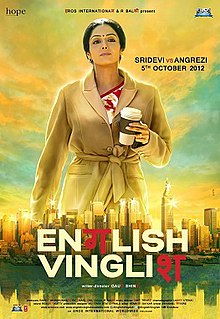
English Vinglish
India (Hindi), 2012
134 min, drama, comedy, family issues
Directed by Gauri Shinde Shashi, a typical Indian housewife who runs a small sweet business out of her kitchen, finds herself belittled and ignored by her husband and daughter for her lack of English ability. When her Indian-American niece announces her plan to get married, Shashi is sent to New York City to help with the preparations. She is frightened because she has never travelled abroad, and she has no confidence in her ability to communicate in an English-speaking world.
After humiliation in a New York cafe, she decides to enroll in an English class with the money she had saved from her business. Part fish-out-of-water comedy, and part critique of women's place in society and the family, this movie demonstrates how people have the ability to learn and be more than they seem to be.
An alien arrives in the Rajasthani desert in western India. The first man he meets takes his "remote control," the shiny medallion that allows him to contact his spaceship, leaving him stranded naked in the middle of the desert with nothing but an old radio. Without his remote control, without being able to communicate with the Earthlings he meets, somehow he must find a way to get back home.
In Belgium around the same time, a romance springs up between Jaggu, an Indian, and Sarfraz, a Pakistani. But when Jaggu tells her parents that she's in love with a Muslim, her father's Hindu guru attempts to break the couple up. The guru's plan works, and the heartbroken Jaggu returns to India to become a reporter in Delhi.
Delhi is where Jaggu encounters the strange P.K., a man who has a very different outlook on life that both rejuvenates and confuses her. When they discover that the guru that opposed Jaggu's marriage is the same person who has P.K.'s remote control, it's up to them to expose the truth and get P.K. home.
 Dangal


_POSTER.jpg/220px-Court_(film)_POSTER.jpg)