Thursday, December 22, 2016

Labyrinth Lost by Zoraida Córdova

Labyrinth Lost
Zoraida Córdova
2016, I read digital review copy
336 pages, YA fantasy, LGBTQIA+

Many thanks to Sourcebooks Fire for providing a review copy of this book! 

Alejandra, or Alex, is a bruja, one of a long line of magical people. While her family is all-important, she’s hiding a secret from them: she does not want to be a bruja. When she tries to escape from her power and ends up sending her family into exile in an alternative realm, it’s up to her, her hired guide Nova, and her human best friend Rishi to save her family and the magical realm of Los Lagos.

Highlight the black sections to reveal spoilers.


Latinx Culture, Religion, and Magic


One of my favorite parts of this novel was the worldbuilding. Set in contemporary Brooklyn, the brujas are both very much a part of New York society and a secretive group that follows different laws. While they perform seances and healing sessions, they still have to pay the bills. The best example of this is Alex's mother, who has healing powers but also works in a gynecologist's office - as a secretary. This made me question why she never went into medicine herself; my guess is that her family did not have enough money to afford medical school. This indicates that the bruja community is very much subject to the same restrictions and racial/income discriminations that others experience, including Latinx communities.

Where do the brujas get their magic? It seems that it comes from two sources. First, their own families, living and dead. The importance of family - the full, extended, complicated and difficult family - is emphasized throughout this book. Despite fighting with her sisters (like everyone does), Alex is fiercely loyal and protective of them. Her decision to remove her own magic is a misguided attempt to protect her family from what she can do; when she accidentally banishes them to Los Lagos, she is wracked with intense guilt for what she sees as her betrayal of the ones she loves.

What Alex does not realize at first is that much of her power comes from her family - both from her long lineage and from the love that her family has for her. Setting aside the magical aspect for a moment, this is an incredibly powerful statement: your family's love for you can give you the strength to do things that you would never be able to do on your own.

On the other hand, in Nova we see the flip side of this importance of family among the brujas. Nova does not have a family, as such: he was abandoned and abused by his remaining relatives. This results in his inability to have a Deathday, and therefore his inability to contain and control his power - which is slowly killing him. Nova's abandonment is not his fault, but in this world - both among the brujas and in human society - he is punished for it.

The second source of bruja magic is their religion, a polytheistic and ancestor-worship belief system inspired by the veneration of saints in Latin American Roman Catholicism, Day of the Dead, and Santería. In addition to revering departed members of their family, brujas worship numerous deities named after natural elements - El Fuego, La Ola, etc. - who bless them with magical powers. The worship of these gods is complex, involving personal altars, offerings, prayers, and spells.

Cordova takes time to flesh out these religious practices: Alex compares her relatively unkempt altar with those kept by her family members, for example. The images and offerings on each person's altar indicate their values and powers. Since each deity grants a specific type of magical ability, each person generally prays to the deity associated with their power. The level of detail provided for these religious practices indicates just how intimately intertwined they are with the daily life of the brujas.

One other thing that I wanted to note is that bruja society is matriarchal: the women are the ones who are usually most powerful and who make most of the decisions. This is quite refreshing.

Positive bisexuality


Another thing that this book does really well is representing bisexuality in a positive way. From the very beginning of the novel, we are introduced to Alex’s as-yet-undiscovered feelings towards her human best friend Rishi. Then she also starts to fall for the hunky and mysterious Nova. Both of these relationships felt like equally valid possibilities.

Importantly, Alex's family is also supportive of queer relationships. This is first indicated by another lesbian relationship in her family (in an older generation), and then by the way her family acts when she finally chooses Rishi. Not only does this book provide an excellent example of bisexual attraction, but it shows a positive response from the main character's strong family unit.

I loved this book for its mythology, its characters, and its worldbuilding. If you haven't read it yet, go read it now.

Want to see more reviews of world literature and film? Follow me on Twitter or like The Globally Curious's facebook page!

Friday, December 16, 2016

Two Webcomics: A Redtail's Dream and Anu-Anulan & Yir's Daughter

Today I'm going to do something a little different and review two webcomics that I recently finished. Both are complete stories that combine fantasy and mythology in a unique way, with gorgeous artwork.

A Redtail's Dream


Minna Sundberg
Finnish and English
Completed, 2011-2013
556 pages, fantasy, boy and his dog

When the residents of a village in rural Finland are accidentally sent into the Realm of Dreams (by the Puppy-fox Spirit, who is left in charge while his elders have a meeting), the loner Hannu and his friendly dog Ville must perform tasks to release their friends and neighbors. 

The story is broken into chapters. In each one, Hannu and Ville find themselves in a different part of the realm of dreams, where they must complete a random task to convince the main villager in that area to return home (and take the others with them). Each main villager is accompanied by an ancient animal spirit; Ville, to his delight and sometimes dismay, takes the same form as the animal spirit while they are there. Hence you have a dog that becomes everything from a squirrel to a moose to a seal. 

And did I mention that Ville can talk?

According to everything I have read, this tale draws heavily on Finnish mythology. Puppy-fox is a classic trickster character, Hannu and Ville's tasks feel like something from a folktale, and so on. However, I was unable to find a detailed breakdown of the mythological elements of this work online. Perhaps it is so close to the original tales that it isn't worth analyzing? I would love to read an in-depth article on the similarities and differences to the myths. 

Most importantly, the art of this webcomic is absolutely stunning. It is well worth reading just for the beauty of it. 


Further Reading: 

"Finnish Mythology" by Molly Kalafut
Read The Kalevala from Sacred Texts

Anu-Anulan & Yir's Daughter


Emily Carroll
English
Completed, 2011
3 pages, fantasy, LGBTQIA+

In this very short comic, the goddess Anu-Anulan requests a woman (Yir's daughter)'s bright, silvery hair. But after she receives it, she realizes something is missing. 

I am not sure if Anu-Anulan is based on any particular deity. Rather, Carroll uses mythlike storytelling to convey a very sweet tale. 

The artwork used for this story is relatively simple, but incredibly expressive. It's only three pages - go read it now! 

Want to see more articles like this? Follow me on twitter or like The Globally Curious on Facebook


Thursday, December 8, 2016

Queen, directed by Vikas Bahl

Queen
India (Hindi), 2013
146 min, comedy, self-exploration, travel
Directed by Vikas Bahl
Starring Kangana Ranaut

When Rani’s fiancée breaks up with her two days before their wedding, she decides to go on the honeymoon by herself. Her first time outside the country, and her first time really alone, gives her the opportunity to explore who she is and what she wants from life.

While in many ways this film draws upon problematic stereotypes of “life in the West,” it still provides a good example of a sheltered young woman steering her own life for the first time.

Self-exploration


In Delhi, Rani lives a sheltered and protected life. Her younger brother acts as her chaperone, especially when she meets Vijay, her fiancée. It seems like her match with Vijay was only partially of her own accord: she wanted an arranged marriage, and this marriage seems to be half-arranged. I’m not sure she really considered any alternatives before making the decision, since she just took marriage as a matter of course.

When Vijay dumps her, she is devastated. She curls up in a ball and cries in her room for a whole day. But she emerges with a decision: she was really looking forward to going to Paris, and had even spent all of her life savings on the ticket – so she wants to go. At this point, she still gives her parents the veto decision, but her father realizes that she needs to do this for herself. Hesitantly, they drive her to the airport and send her on an adventure without them.

At first Rani is incredibly overwhelmed, lonely, and just wants to go home, but then she makes friends and begins to enjoy herself. As she does so, she realizes that she doesn’t need a man to have fun or to travel. She also realizes that some of the assumptions she was making about other people were wrong. For example, although she has been taught that all men are scary, she ends up befriending her three male roommates at a hostel in Amsterdam. Over the course of the film, as she continues to try new things, she becomes less afraid and more independent.

The Indian jerk boyfriend


This film directly addresses one of my pet peeves about Indian movies: the valorization of abusive (even stalker!) boyfriends. After Vijay dumps her suddenly, with no thought about her feelings, Rani accidentally sends him a picture. Seeing this selfie, Vijay suddenly realizes that he actually still loves her. He begins calling her repeatedly, and even goes to Paris and then Amsterdam to track her down.

At first, Rani doesn’t know what to do about this. She is angry, but society has taught her that she should forgive him. When he suddenly appears in Amsterdam, she is willing to talk to him privately - even after he tries to beat up one of her new friends in a fit of over-possessive stupidity! Finally, at the end of the film she realizes that his behavior is not acceptable and that he does not deserve her.

I was happy that Rani, unlike many Bollywood heroines, comes to the realization that stalking and over-possessive behavior is not romantic.

Buying into stereotypes of the West


My biggest problem with this film is the incredibly stereotypical depiction of the West. As usual, Rani’s character exploration is accompanied by large amounts of drinking, clubbing, and visiting red light areas (in Amsterdam, of course). Like other films of this genre, it seems like the only way Rani can loosen up is by literally wearing less clothes and drinking. Obviously, this isn’t all that happens in the West – but if you watch Indian movies you would be forgiven for thinking so.

Rani has two potential love interests in Amsterdam, one an Italian restaurant owner and the other one of her roommates. Of the three roommates, the one who catches her eye is the only white person; the others are a black Frenchman and a small Japanese man. The depiction of the Japanese character fits into the racist depiction of Asian men as cute but sexually unattractive; the Black character has barely any speaking lines. It is the hot, emotional, artistic, very white Russian who catches her eye. This reinforces the idea that the only foreigners worth dating or marrying are white people – an idea that is quite prevalent in Indian society.

Despite these rather significant problems, the powerful portrayal of Rani’s voyage of self-discovery makes this movie worth watching. I recommend it as an exploration of how being alone teaches you about who you really are.

Want to see more reviews of world literature and film? Follow me on Twitter or like The Globally Curious's facebook page!

Thursday, December 1, 2016

Islamicates: Volume I, edited by Muhammad Aurangzeb Ahmad

Islamicates: Volume I
Anthology of Science Fiction short stories inspired from Muslim Cultures
Edited by Muhammad Aurangzeb Ahmad
2016, available for free here
236 pages, speculative

Personal note: 

It seems appropriate that my first post after the election concerns a book inspired by Islam and Islamic cultures. Among the many, many evils that have been drawn out of the woodwork by the new president-elect's policies, I am the most worried about the marked increase in Islamophobia. 

This freely available book presents many different perspectives on Islamic people and societies. In some stories, religion is outlawed and people must fight to continue following their beliefs. In others, religion is the problem that people are fighting against. But in all of them, Muslims are shown as they truly are: people trying to make their way in the world, fighting against circumstances outside of their control, just like everyone else. Many of these stories draw upon events that are currently happening: the war in Syria, the Refugee Crisis. Some reverse the flow of migration so that Europeans become the migrant workers. All of them speak to parts of Islamic society that many people in the West are unaware of. 

I encourage everyone to read through some of the stories in this collection, and to share them with friends who might have doubts about this religion and the people who follow it. At this historical moment more than ever, I consider it a moral duty to spread diverse literature in order to combat the prejudices, xenophobia, and, yes, White supremacy that is growing like a cancer in many parts of the world. Please join me by supporting works that combat stereotypes about People of Color and other minorities. 

In this collection published by the excellent website Islam and Science Fiction, authors from around the world have created science fiction short stories inspired by Islamic cultures. The works presented are the 12 best of those submitted for the first Islamicate Short Story contest run by the same website.

Since there are so many stories, I will only provide an analysis of the ones that really spoke to me. However, I highly encourage you to read the others as well.

“Calligraphy” by Alex Kreis (USA)


After a rivalry between two tile makers turns dark, the remaining one laments his actions.

This story uses the formal and slightly stilted language of Victorian translations from Arabic, which I quite enjoyed. Unlike the rest of the stories in this collection, it is set in the past. On the first reading I was confused about its inclusion in this collection, since it didn't seem very much like science fiction. But then it struck me that it taps into the history of scientific exploration and discovery in the Muslim world during the medieval period. The narrator sees something that he does not understand, but which was created through advanced scientific and artistic skills, and voila: a fascinating science fiction story set in the past.

“Insha’allah” by R.F. Dunham (USA)


It seems like a normal state of affairs - an adult child is more comfortable with a new technology than her parent is - but in this case the technology allows one to know the future, and the father Khafid is the inventor who has since forsworn his creation.

This story deals with the lack of intergenerational communication that can happen based on the life experiences of older family members, as well as whether all inventions are necessary. What criteria would make a technology bad (not evil, just extremely misguided)? After much reflection, Khafid has decided that his invention was a bad idea for several reasons, not least because of his faith, but he has trouble expressing that to his daughter in a way she would understand. Anyway, his daughter refuses to listen and has instead decided to improve the device by increasing its temporal range. As you can probably guess, this is a bad idea.

Wednesday, November 2, 2016

Ajjiit: Dark Dreams of the Ancient Arctic by Sean A. Tinsley and Rachel A. Qitsualik

Ajjiit: Dark Dreams of the Ancient Arctic
Sean A. Tinsley and Rachel A. Qitsualik
Illustrated by Andrew Trabbold
2011
191 pages, speculative fiction, indigenous

Many thanks to Inhabit Media for providing a review copy of this book, and to my mother for sending it to India as a Christmas present last year! 

This collection includes nine innovative speculative fiction stories that are inspired by traditional Inuit society and folklore.
To a degree, our point, in crafting these fantasy stories, was to draw upon Inuit culture and lore, writing original fiction utilizing the unique creatures and concepts that Inuit once (and, in some cases still do) fear or revere [sic]. Our main purpose, however, was to illustrate a sort of cosmological thinking particular to Inuit culture - a mystic tradition, if you will, that is not unlike the Arctic itself: barren to the superficial eye, yet filled with riches for those willing to fix a deep and non-judgemental stare. - Authors' introduction

“Elder”


Pigliq, one of the Humble Folk, is a poor sleeper – he can’t fall asleep properly, and his friend has to dream clothes for him. This leads to ridicule and complaints. But when his people awake from their latest slumber to find a terrifying new threat, it’s up to Pigliq to save them all.

Besides tapping into a fantastically unique race of humanoid beings from Inuit mythology, Pigliq’s unique plight – not being able to sleep, and therefore to dream – is compelling. He is considered disabled and is bullied for his differences from his peers, but in the end his "disability" is what allows him to fight when no one else can.

“The Qallupiluq Forgiven”


The Qallupiluq is a terrifying shapeshifter from Inuit mythology, who has the prerogative to kidnap and eat anyone who says its name.

This story was one of my favorites in Moonshot: The Indigenous Comics Anthology Vol. I.

Monday, October 24, 2016

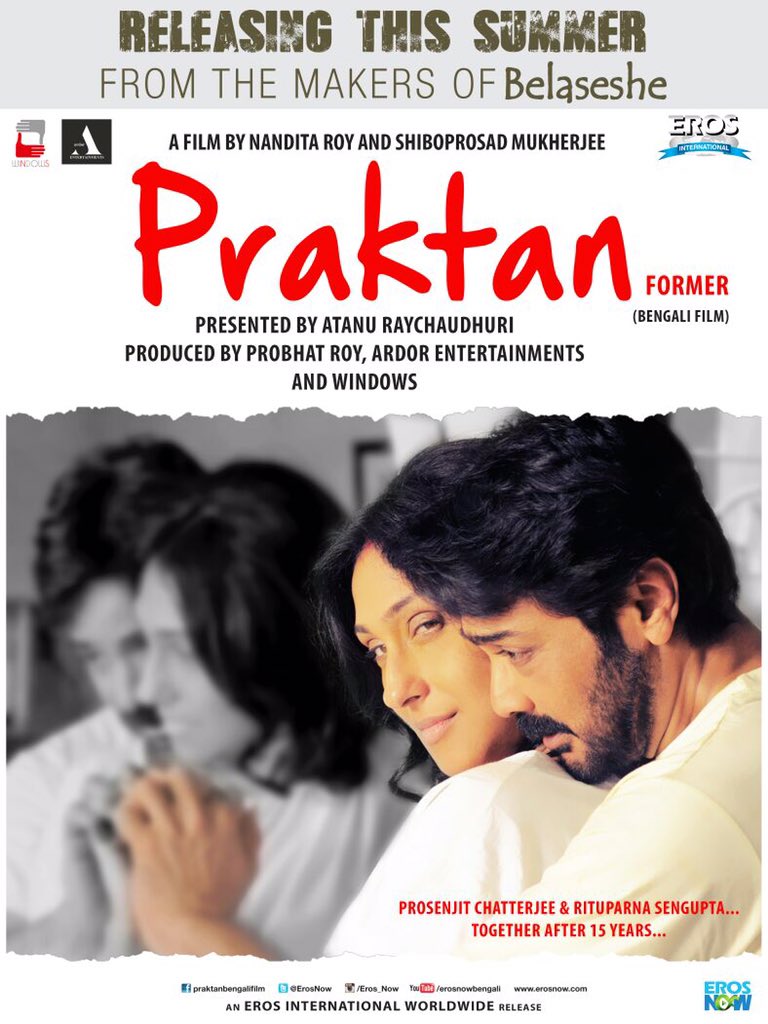
Praktan, directed by Nandita Roy and Shiboprosad Mukherjee

Praktan
India (Bengali), 2016
143 min, drama
Directed by Nandita Roy and Shiboprosad Mukherjee
Starring Rituparna Sengupta, Aparajita Auddy, and Prosenjit Chatterjee

Content Warning: Discussion of Emotional and Physical Abuse

Ten years ago, Sudipa and Ujaan divorced after a difficult marriage. Today, Sudipa finds herself in a first-class train carriage from Mumbai to Kolkata with Malini, Ujaan’s new wife, and their daughter. During the course of the two-night train journey, Sudipa finally deals with the pain from years before.

Meanwhile, we see the stories of people in other rooms in the same carriage. Four famous Bengali musicians (Surojit Chatterjee, Anindya Chatterjee, Upal Sengupta, and Anupam Roy, playing themselves) serenade each other with new compositions. An elderly couple returns from Mumbai after seeing their son off to the US. And last but not least, a couple of newlyweds put the trip in a private cabin to good use.

Both an intimate story of pain, heartbreak, and healing, and a glance at the things that happen in first class, this is a new, great train movie from West Bengal. However, the ending left a bad taste in my mouth.

Thursday, October 20, 2016

Blackass by A. Igoni Barrett

Blackass
A. Igoni Barrett
2015, I read PDF review copy
304 pages, social satire, speculative

Many thanks to Kachifo Limited for providing a review copy of this novel. 

Furo Wariboko awoke this morning to find that dreams can lose their way and turn up on the wrong side of sleep. He was lying nude in bed, and when he raised his head a fraction, he could see his alabaster belly, and his pale legs beyond, covered with fuzz that glinted bronze in the cold daylight pouring in through the open window…. His hands were not black but white… same as his legs, his belly, all of him.

Thus begins this Kafkaesque satire about race relations in Nigeria. Furo wakes on the morning of a big job interview to find that he has suddenly turned White – complete with red hair and blue eyes. Escaping from his house, he turns up at the job interview and, as a White man, finds that not only his job prospects, but every other aspect of his life has significantly improved.

Being White in a post-colonial society


Furo encounters all of the things that I, myself, have experienced or witnessed as a White person living in a post-colonial society (in my case India). Using the same qualifications that had lost him numerous opportunities in the past, as a White man he is immediately offered a good job. People trust him enough to give him money within two minutes of meeting him.

He also receives intense stares everywhere he goes:
Lone white face in a sea of black, Furo learned fast. To walk with his shoulders up and his steps steady. To keep his gaze lowered and his face blank. To ignore the fixed stares, the pointed whispers, the blatant curiosity. And he learnt how it felt to be seen as a freak: exposed to wonder, invisible to comprehension.
As a White man, Furo is expected to act a certain way; when he doesn’t fulfill people’s expectations they become surprised and start to question him. When he tries to eat in a roadside restaurant, for example, people stare and ask why he is there. To escape the stares, he goes into one of the city's fancy shopping malls (which he has never previously entered), and fakes casualness while drinking an incredibly expensive coffee. As a White person, he is not only expected to have a lot of money, but also to fit naturally into high society.