Showing posts with label Best of. Show all posts

Wednesday, January 3, 2018

Ruins by Achy Obejas

Ruins 
Achy Obejas
2009
205 pages, drama, character study
Found: A signed first edition (!) at a secondhand bookstore somewhere in India

Usnavy, a proud veteran of the Cuban revolution, is as much of a straight-shooter as it is possible to be. Despite the deprivations that have made life miserable for him and his family, he refuses to do anything illegal. The other employees at the bodega (government ration supply store) may sell products out of the back before they can be parceled out, but Usnavy refuses. He is happy to do the most miserable of government jobs - and be the one who gets abused about the lack of supplies or the need to collect funds for public projects - because he truly believes in his country and the purpose of the Revolution.

Where everyone else has given up, Usnavy continues to go on, an idealist till the end.

And then one of his best friends leaves the country by boat, and recruits Usnavy's help. And Usnavy is suddenly compromised for the first time. And suddenly Usnavy becomes truly aware of the deprivations and the ways he could make money to better himself and his family's position.

Hunger and food shortages


This book is best at getting you into the head of someone dealing with great deprivations, especially those caused by food shortages. There is no way that the government can provide enough food for people, so they are left to scrounge around for whatever they can find (or buy, or steal, or sell). Usnavy's constantly empty, rumbling stomach is an unceasing companion. The author conveys this all-consuming hunger so viscerally that I could feel my own stomach twisting as I read it:

Usnavy watched as [his wife] Lidia served up a sandwich for [their daughter] Nena that he recognized as having what looked like a reddish-brown meat. His immediate fear was that it was cat flesh. As a delighted Nena ate - complimenting Lidia, savoring the little bits of what looked like onions - Lidia kept busy, avoiding Usnavy's eye.... Of all people, of course, he knew that the only ingredient she'd gotten legally for that sandwich was the bread. (35)
But no sooner had Usnavy pulled up the bread and seen the flat layer of pith covered in seasoning, than he recognized its true provenance: These were pieces of a blanket normally used for mopping floors which [their neighbor] Rosita had beaten and marinated in spices and a little beef broth.... At least it wasn't cat meat, he thought. 
Then he bowed his head in dismay and disbelief. (37-8) 
What happens when basic necessities are only available on the black market, and you have to do illegal (and sometimes immoral) things to get the cash to pay for them? Especially if you believe so strongly in the rightness of the government and the society that you are a part of?

These are all moral questions that Usnavy struggles with in this book, and the constant hunger lends a sense of urgency and desperation to everything. What won't someone do when faced with such a situation?

Fear of flight


Usnavy spends much of the book trying to prevent his daughter from running away - from fleeing to the US, which beckons more and more with every day of starvation. It seems so close, and yet it is so far from everything that Usnavy ever wanted for her, or for them.

Usnavy has always been made fun of for being light-skinned, having red hair, and being so naive as to truly believe in the revolution. But he has also been fighting for the revolutionary values because he does not want things to change. He wants his struggle in the war to be worth something; he wants his country that he fought for to be worth something. And somewhere in his mind he worries that it is maybe not worth anything after all. What is the use of a country that can't even provide its own people with food to prevent starvation?

So he vehemently opposes the flood of people leaving the island for brighter shores, but also wonders when he will have to follow them. When he will himself turn traitor to the cause that he spent his life serving.

And of course that terrifies him.

Gender issues


I cannot write a review without examining the very delicate but incisive discussion of gender issues in this book. 

First, Usnavy's wife and daughter seem like women who have been forced to give up their desires for the sake of the man in their life (i.e., Usnavy). Lidia, Usnavy's wife, used to be a driver for a hospital, and, as Usnavy mentions, was "one of the first women to really excel at the job." However, due to budget cuts she was laid off and not provided with an alternative job that would pay appropriately. So now she is stuck in their tiny apartment, trying to eke out meals from the tiny amount of supplies that her husband brings home. 

Their daughter, Nena, is in a similarly stuck position. Not only will Usnavy not allow her to break any of the oppressive government rules, but she is stuck between school and home because he will not allow her to access his bicycle - not even as a loan! 

While Usnavy does give some thought to his family's position (especially in terms of hunger), his thoughts are mostly on himself. He never asks whether Lidia and Nena are ok with giving up opportunities to follow his principles. Usnavy spends most of his time outside of the house, whether at the bodega or playing dominoes with his friends; when he is not at home, he still takes up most of the space with his large stained-glass lamp (more on this below). It is a very claustrophobic situation for the two women, and there seems to be little thought on Usnavy's part about whether they really want a life like this.

Second, the novel masterfully details how relatively uneducated, ordinary people deal with trans issues. The "son" of one of Usnavy's friends is in the US, where "he" is reportedly doing well. When "he" comes to visit, however, it turns out that she has transitioned. While her father knew (and seems accepting), he had been ashamed to admit that his son was now a daughter. And his fear appears to be justified when another friend reacts violently to the news. But Usnavy does not seem to have a problem with the situation; sure, it is a bit unusual, but then as a kid she was always different. I would be very interested to hear the thoughts of a trans individual on this aspect of the book, particularly how they read Usnavy's reaction to her transition. 

A jeweled mystery


Usnavy's life is consumed by a large piece of his family heritage: a beautiful glass lamp that not only provides some comfort and beauty to his otherwise bare, meager life, but also inspires him to make changes to that life later in the novel.

To relieve the gloom, the family's room - a breadbox, a shoebox - was illuminated by a most extraordinary lamp. Were it not for the sheer size of it, Usnavy could have built a second floor - a barbacoa - like many of his neighbors. Made of multicolored stained glass and shaped like an oversized dome, the lamp was wild. Almost two meters across, the cupola dropped down with a mild green vine-and-leaf motif that flowered into luscious yellow and red blossoms, then became a crimson jungle with huge feline eyes. (In truth, they were peacock feathers, but Usnavy had never seen or dreamt of peacocks, so he imagined them as lions or, at least, cats.) The armature consisted of branches at the top, black and fat to resemble the density of tree bark. They narrowed as they neared the edge, until they were pencil thin and delicate. The borders were shaped with the unevenness of leaves and eyelids, petals and orbs, in a riotous yet precise design. (17)

This glorious lamp is the source of Usnavy's greatest joy. He knows it has something to do with his family's past; it was a feature at his mother's house in his childhood, but she had never explained its provenance or how it had come into their family's possession. He spends hours just looking at the lamp, polishing it, making sure it glows with all possible intensity. This obsession seems to take precedent over everything else in his life, including his family members.

It is only when a chance encounter shows him that there are other lamps like his (although smaller, less elaborate, not as beautiful) that he realizes he is sitting on a goldmine. He begins to use his knowledge of the lamp and its brothers to make some money, to improve the family's state of living. He sells the other lamps and the glass from the other lamps, but he is reluctant to touch his own unless absolutely desperate. And so he begins to walk a fine line: neglecting his official work in favor of an alternative industry of selling glass, while also refusing to allow anyone to see his own lamp. Eventually all of this has to catch up with him, somehow.

I absolutely loved this novel, and I cannot recommend it highly enough. It is both a good literary investigation of life in Cuba during the early years of the Special Period and a brilliantly written and paced novel.

Further Reading

"Was the 'Special Period' a Cuban Invention?" by Dmitri Prieto (Havana Times) 
"Cuba’s 'Special Period' Remembered" by Irina Pino (Havana Times) 
"The Maleconazo, Cuba’s First Popular Revolt, Happened 23 Years Ago" by Ivan Garcia (Translating Cuba)


Want to see more reviews of world literature and film? Follow me on Twitter or like The Globally Curious's facebook page!

Thursday, June 9, 2016

Sardaarji by Rohit Jugraj

Sardaarji
India (Punjabi), 2015
140 min, comedy, fantasy, romance
Directed by Rohit Jugraj
Starring Diljit Dosanjh, Neeru Bajwa, and Mandy Takhar

Jaggi, or “Sardaarji,” is a talented ghost hunter from rural Punjab, India. Emotionally immature, he is waiting to find his “queen witch:” the prettiest and most wonderful female ghost, who he will add to his bottled collection.

When he gets a call for help from a rich expat family living in the UK, he flies to London to exorcise a ghost from a castle. The ghost turns out to be a Punjabi named Pinky, and Jaggi decides that she will be his queen ghost.

There’s only one small problem: before Pinky will leave the castle, Jaggi must romance Jasmine, a real, human girl – something that terrifies the intrepid ghost hunter.

Emotional Immaturity


I had great suspicions about Jaggi (and the writers) at the beginning of the movie. It seemed like the women were being treated in a very patriarchal way: the female ghosts are literally kept in bottles in a cabinet while Jaggi flirts with them and makes sexual innuendos. This is incredibly problematic, but it turns out that most of this can be chalked up to his emotional immaturity: emotionally, Jaggi is about as mature as a 13-year-old, if that.

This becomes most obvious when Pinky’s plan requires him to learn salsa dancing from Jasmine. She takes his hand and places it on her back in the correct position for ballroom dancing. Jaggi nearly faints and runs away. The reason? He has apparently never touched a girl before – well, except for the she-ghosts, who are ghosts so it doesn’t count – so he is terrified when Jasmine touches him.

This emotional immaturity is indicated in several more minor ways throughout the film. For example, Jaggi’s outfits swing radically between a full suit-and-tie and footie pajamas. He constantly has to ask ghosts for advice, especially about relationships, and only realizes that he is in love when a random ghost tells him so.

Read the rest on The Asian Cinema Blog


Want to see more reviews of world literature and film? Follow me on Twitter or like The Globally Curious's facebook page!


Thursday, June 2, 2016

Like a Mule Bringing Ice Cream to the Sun by Sarah Ladipo Manyika

Like a Mule Bringing Ice Cream to the Sun
Sarah Ladipo Manyika
2016, I read advance review copy
129 pages, comedy, everyday

Many thanks to Cassava Republic Press for providing a review copy. Cassava Republic is a major Nigerian publisher and has just started a new operation in the UK. This is one of their first UK titles. 

Dr. Morayo Da Silva is a retired English professor living in San Francisco. As she goes about her daily life, she comes into contact with other ordinary people, each one extraordinary in their own way. In this gorgeous little book, tiny everyday actions and interactions – buying flowers, visiting a friend, reading a book – come to life and reveal their true importance.

The Everyday


Small things that are apparently ordinary tend to get lost amongst the “bigger issues” in life. But they are no less important –in fact, they are what life is made of. Morayo embraces the beauty of the everyday and engages with life and with other people at a profound level. For example, when Morayo sees a young homeless woman on the road, she stops to check if she is ok. This leads to a conversation that goes deeper than normal, superficial small talk, cutting through to what is really important.

Morayo used to be married to a Nigerian diplomat, so she has travelled extensively and lived in many countries across the world. This multicultural background helps her to appreciate the vibrancy of the world around her in San Francisco, to delight in the little pleasures that remind her of places she has been or people she used to know. This gives her narrative a great depth and ingenuity that is a pleasure to read. She is one of those characters who would be a great friend, if she were real.


Read the rest of my review on Shiny New Books.


Want to see more reviews of world literature and film? Follow me on Twitter or like The Globally Curious's facebook page!

Monday, May 2, 2016

Neerja by Ram Madhvani

Neerja
India (Hindi, English, Arabic), 2016
122 min, thriller, biography
Directed by Ram Madhvani
Starring Sonam Kapoor and Shabana Azmi

On September 5th, 1986, Palestinian terrorists hijack Pan Am flight 73 while it waits on the tarmac at the Karachi airport. The head purser of the flight, Neerja Bhanot, tries to keep the passengers safe by negotiating with the terrorists and trying to outwit them. Based on a true story, this movie depicts how Neerja became an international hero by saving the lives of most of the passengers and crew, while dying herself.  Meanwhile, we see the emotional fallout at home of knowing that your daughter, sister, or girlfriend is in mortal danger – and there’s nothing you can do to help her.

While this could have easily become melodramatic, the powerful performances of Sonam Kapoor as Neerja and Shabana Azmi as Neerja’s mother imbue this film with the right mix of tension, fear, and bravery to make it one of the most lifelike and emotionally complex films I have ever seen. I think this is the only movie that has left me bawling in my seat at the movie theater, and I daresay you will have a similar experience.

Neerja’s history of abuse


While it doesn’t go into great detail, the movie does explore Neerja’s history of surviving intimate partner violence. After having an arranged marriage, she is taken to Oman by her husband, who proceeds to verbally and emotionally abuse her – finally escalating into physical violence. Part of this abuse is letters sent to her father demanding that he give more money for her dowry.  When Neerja escapes from this terrible situation and returns to her parents’ house, she has to deal with the social and familial censure of her actions. As a woman, she should have been able to accept and adjust to any situation, or so the logic goes. Neerja bravely perseveres in doing what is right for her: getting a divorce, picking up her modeling career again, joining PanAm as a stewardess, and just generally creating a new life for herself.


Read the rest on The Asian Cinema Blog


Want to see more reviews of world literature and film? Follow me on Twitter or like The Globally Curious's facebook page!

Friday, March 11, 2016

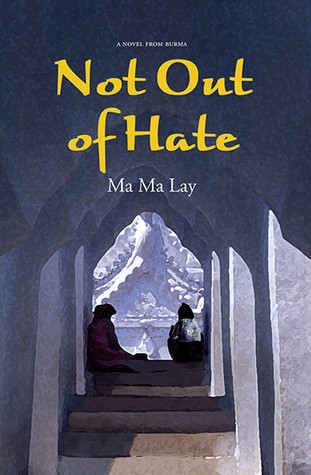
Not Out of Hate by Ma Ma Lay, Translated by Margaret Aung-Thwin

Not Out of Hate
Ma Ma Lay (Ma Tin Hlaing) (1917-1982)
Translated by Margaret Aung-Thwin (Burmese)
Original published 1955; I read 1991 English translation, Silkworm Books 2006 edition
216 pages, psychological, social commentary, love story(?)

Many thanks to Silkworm Books for providing a review copy of this book, and for meeting with me when I visited Chiang Mai, Thailand. 

Trigger warning for discussion of intimate partner abuse.

Way Way is a 17-year-old girl who has been brought up in a traditional Burmese family. Her father runs a rice export business, and her mother left several years ago to become a Buddhist nun. Way Way dearly loves her father and, as the only child left at home when his health takes a turn for the worse, cares for both him and the business.

When a new neighbor arrives, a thoroughly Anglicized Burmese man named U Saw Han, Way Way is struck by his sophistication. She becomes ashamed of the difference between U Saw Han’s English style (of food, furniture, clothing, and so on) and her own rural Burmese style. U Saw Han, in turn, is struck by the contradiction between Way Way’s apparent innocence and childlike behavior and the responsibilities she takes on in the household and business. When they get married, Way Way realizes that his British airs, and his insistence that she also follow them, are not actually what she wants – but at that point there’s no turning back.

Abuse


After their marriage, U Saw Han is thoroughly abusive toward Way Way, although he doesn’t seem to realize it. “Out of love” he prevents her from eating the food she likes, wearing clothes that she wants to wear, and even visiting her ailing father. This culminates in refusing to allow her to visit her dying father after she receives an urgent telegram.

Wednesday, January 20, 2016

1Q84: The Complete Trilogy by Haruki Murakami, translated by Jay Rubin and Philip Gabriel

1Q84: The Complete Trilogy
Haruki Murakami
Translated by Jay Rubin and Philip Gabriel (Japanese)
Originally 2009-2010, I read 2012 Vintage paperback edition
1318 pages, speculative, psychological, friendship, romance

Aomame, whose name means "green pea," has a complicated past and an even more complicated present. When she finds herself in an altered reality, she must determine the new rules if she wants to survive.

Tengo is a cram school mathematics teacher and aspiring fiction author. When his editor asks him to ghostwrite a revised version of a novella, he has moral qualms – but in the end, the story is so compelling that he accepts, unknowingly falling into danger.

In this marvelous trilogy, Murakami takes us into the world of these two lonely people. But what is real? And why are there suddenly two moons in the sky?

Friendship


One of the things I like most about Murakami’s writing is the way he focuses on friendship. The friendships in this novel feel solid, real. This is something that is not very common; authors have a tendency to focus only on romantic relationships. It is incredibly refreshing to read a deep work about friendship itself.

Aomame’s character is particularly shaped by her strong friendships. One of her very good friends from when she was a teenager committed suicide, which severely impacted Aomame’s emotional state. This is normal and completely understandable, and not something authors emphasize enough. In the course of the novel, another of Aomame’s female friends is the victim of a gruesome murder. When she hears, Aomame cries for days. Importantly, she lets herself cry for days, performing the necessary emotional work to deal with her grief. Then there is her friendship with her employer, the Dowager, a close relationship that is almost familial. Both of them rely on this strong, intergenerational friendship.

Saturday, October 31, 2015

The Orphanage, directed by J. A. Bayona

Spain (Spanish), 2007
105 min, drama, thriller, horror
Directed by J. A. Bayona
Starring Belén Rueda, Fernando Cayo, and Roger Príncep

For Halloween, I thought I would review one of the most terrifying movies I've ever seen. 

Laura returns to the now-abandoned orphanage where she spent her childhood, planning to open a home for disabled children with her doctor husband, Carlos. They bring along their son, Simón who doesn't yet know that he is HIV positive and adopted. 

Soon after arriving in their new home, Simón begins acting strangely. He suddenly has new, invisible friends, who reveal the secret of his adoption and his illness to him. After a fight with his mother during their business's opening party, Simón disappears. Laura will stop at nothing to find her son, and in the process discovers the secrets hiding behind her childhood in this house.


Monday, October 5, 2015

The Circle of Karma by Kunzang Choden

Kunzang Choden
2005, published by Zubaan
316 pages, woman's life story
Found: Kolkata Book Fair 2015

This book tells the life story of Tsomo, an illiterate woman from rural Bhutan. Tsomo’s life takes her to places she never expected – India, Nepal, Bodh Gaya – and through experiences that are unusual, to say the least. Although she was never able to learn how to read or write, she is a devout Buddhist. Illiteracy and illness cannot stop her from going on pilgrimages, or from becoming a devotee of Rinpoche, a refugee monk from Tibet. Or from finally becoming a nun toward the end of her life, focusing her energies on worship at the National Memorial chorten in Thimphu, the capital of Bhutan. Her life is one of suffering, friendships, travels, sickness, and joy – but that is just because of her karma.

Muddling through 


For personal reasons, Tsomo runs away from her family home when she is in her early 20s. When she arrives in Thimphu, she has no money, so she takes a job on a road-building crew, breaking rocks into gravel for long hours every day. As an illiterate, uneducated rural woman with few profitable skills and nowhere to call home, this job is the best she can hope for. But she doesn’t mind it, and because she is a friendly and garrulous person she manages to make friends that help her endure the hardship. Not wanting to stay on the road crew, she saves money and keeps moving, first arriving in Kalimpong, a Himalayan city near Darjeeling in India, and later going on pilgrimages farther to the west. While she moves frequently, she never really consciously decides to move: she is invited to travel with friends, or to stay with friends, or she likes a place and decides to stay. Because she is poor and homeless, there is no reason for her not to move to another place. In this unconscious way, she becomes relatively free of material attachments even before she becomes a nun.  

Wednesday, September 9, 2015

A Planet for Rent by Yoss, translated by David Frye

A Planet for Rent
Yoss (José Miguel Sánchez)
Translated by David Frye (Spanish)
First published 2011, I read English language ebook 2014
266 pages,  hard science fiction, satire

Many thanks to Restless Books for providing a review copy of this novel. 

I first heard about the Cuban Science Fiction series from Restless Books sometime earlier this year (probably in this New York Times article). Immediately, I knew that I had to read and review them. Here is a chance to read international science fiction, my favorite genre, that had been completely off my radar. This book is the first I have read from the series, and it did not disappoint.

The novel tells several intertwined stories, featuring characters that are loosely related through mostly random events. Yoss does not bother to flesh out the connections between the characters, instead relying on the reader to figure that out for themselves. This trust in the reader's intelligence was quite refreshing, and it also made the satirical aspects of the story more apparent. It also made the ending harder to predict; for the first time in a long time, I was actually surprised by a book! This may have been because I was reading an ebook, which always makes it a bit more difficult for me to follow the story and pick up on clues.

The basic background is that aliens have *cough* invaded the earth, and taken complete control, forcing humans to be second-class citizens solely used for the purpose of bringing (mostly sexual) pleasure to the xenoid tourists. *cough* Sorry, I must be coming down with a cold or something. As I was saying, aliens have saved humanity by restoring the environment and bringing peace to the planet, making it a very safe place for tourists to visit.

Sunday, August 23, 2015

Caged in Paradise and Other Stories by Rizia Rahman, edited by Niaz Zaman and Shirin Hasanat Islam

Caged in Paradise and Other Stories
Edited by Niaz Zaman and Shirin Hasanat Islam
Translated from Bengali
2010
215 pages, short stories, drama, realism, satire

Thank you to UPL for providing a review copy of this book. 

Full Disclosure: I am currently doing an internship with the publisher which includes marketing products including this one. However, the views presented here are my own. 

When I brought up the idea of promoting some literature for Women in Translation Month, my boss's face lit up. "I know the perfect one!" she said, and recommended this short story collection. While paging through the collection to find quotes that we could use for marketing, I found myself being mesmerized by the stories; after skimming the first fifty pages or so, I immediately asked for a review copy. And I was not disappointed - this book, it turns out, is one of my absolute favorite story collections.

Rizia Rahman is a renowned Bangladeshi author. She has been writing short stories and novels since the late 1960s, and received the Bangla Academy Award, the top literary award in the country, in 1978. Before picking up this book, I had never heard of her. Now I'm thinking about buying one of her novels in the original Bengali before I leave the country next month.

The stories in this collection span the length of her career. They deal with personal challenges, community grief, village politics, changing social mores, women's and human rights discussions. Whereas her earlier stories are more straightforward, demonstrating realistic and relatively linear storytelling, her newer ones move toward magical realism and impressionism. All are handled with marvelous skill, providing glimpses of everyday (and not-so-everyday) life in Bangladesh.

Wednesday, June 24, 2015

The Devourers by Indra Das

The Devourers
Indra Das
2015, Penguin India
344 pages, speculative, fantasy, historical fiction, LGBTQA+

Many thanks to Penguin India for providing a review copy of this book. 

In present-day Kolkata, Alok Mukherjee, a lonely history professor, meets a man who claims to be a werewolf. Well, a half-werewolf. Intrigued by this man and his stories, Alok agrees to do some work for the stranger: he will type a transcription of the stranger's handwritten translation of some old texts. What Alok finds in those pages continues to lead him into a world that he did not know existed - a world filled with supernatural beings, shapeshifters who live in tribes in every part of the world. According to his new acquaintance and the texts he transcribes, Alok comes to know that all the myths and legends that humanity has created are descriptions of these fantastic beings who are so different from us. Through this work and his friendship with the stranger, Alok discovers the complexity and simplicity of his own needs, leading him to let go of his lonely past and move toward a happier future.

What is in the texts? There are two, written by separate authors. The first is written by a Northern European shapeshifter known as Fenrir, one of three who have arrived in India during the Mughal Era, probably in the late 1630s. In a caravanserai in Mumtazabad, the city of the builders of the Taj Mahal, he meets a lone woman, Cyrah, a wanderer of Persian origin who is currently working as a prostitute. Instead of buying her time and body, he asks only for a lock of her hair. But then he returns that night and rapes her, intending to impregnate her with his child so that he can reproduce. Having sex with a human is taboo amongst the shapeshifters, and the resulting argument ends with the three-person pack breaking up.

The second text is written by Cyrah, lovingly addressed to her child, the product of this supernatural rape. In an attempt to track down her rapist, Cyrah joins forces with Gévaudan, one of his former packmates. Gévaudan is much younger than Fenrir, and has his own reasons for wanting to find his old friend. Cyrah wants to punish her rapist for what he did, and, perhaps, get him to take away the child that he gave to her. If, of course, he is a djinni like he claimed to be.

In the visceral telling of these stories, we uncover a tale of blood and love and sex and violence, one that will stay with me for years to come. Without hesitation, I can say that this novel is one of the best works of fantasy that I have ever read. It deals with difficult discussions of violence, gender, and love with a confidence that few writers can muster, especially in a debut novel.

As of this writing, it seems that Penguin has not released this novel outside of the Indian subcontinent. I hope to see it available in the US and UK soon. It would be very disappointing to see this wonderful novel confined only to South Asian readers, when the rest of the world needs to have access to it as well.

Monday, June 22, 2015

Castaway on the Moon directed by Lee Hae-jun

Castaway on the Moon
South Korea (Korean), 2009
116 min, drama, comedy, psychological exploration
Directed by Lee Hae-jun
Starring Jung Jae-young and Jung Ryeo-won

After trying and failing to commit suicide, a man finds himself washed up on a desert island in the middle of the river, in the middle of Seoul. Despite his proximity to the people on the boats and the bridges near him (a major bridge passes over the island itself), he is unable to escape or get anyone's attention. Freed of all normal social constraints, he builds a solitary life on his island.

Meanwhile, he is discovered by an agoraphobic girl, who hasn't left her room in three years and spends most of her time online, pretending to be someone else. Her hobby is taking pictures of the moon through a long telescoping lens, through which she accidentally spots the castaway. She begins taking pictures of him, documenting his life from her bedroom window.

They begin to communicate through short English phrases, scraped in the sand and dropped from the bridge in bottles. But how long can this situation last?


Wednesday, May 13, 2015

Colorless Tsukaru Tazaki and His Years of Pilgrimage by Haruki Murakami, translated by Philip Gabriel

Source: Goodreads
Colorless Tsukaru Tazaki and His Years of Pilgrimage
Haruki Murakami
Translated by Philip Gabriel (from Japanese)
First published in Japanese in 2013, I read 2014 translation
298 pages, friendship, loss, grief, rediscovery

In high school Tsukaru Tazaki had four close friends, two girls and two boys. Except for Tsukaru, everyone's name had a color in it: Blue, white, black, and red. He felt a bit left out. But for years, until Tsukaru's second year in the University, the five of them were the best of friends.

That was when they suddenly banished him from their group, giving no explanation and cutting off all contact.

At the age of 36, Tsukaru is still drifting, unable to form intimate relationships. He lives in Tokyo and has a good job designing railway stations, something he has been interested in since he was a little kid. Then he meets Sara, a hard-working professional who wants to know about his high school life during their first date. Surprised, he finds himself opening up to her. His search begins - to discover what happened all those years ago, to meet his friends again, and to mentally heal himself so he can begin a new relationship.

This is the first Murakami book I have ever read and I absolutely loved it. I was very happy to see that it made both the shadow panel and official International Foreign Fiction Prize shortlist. I look forward to reading more works by Murakami in the future.

The King's Harvest by Chetan Raj Shreshta

Source: Goodreads
The King's Harvest
Chetan Raj Shreshta
Published 2013 by Aleph Book Company
151 pages, novella, crime, social commentary, women's rights, peasant issues, historical fiction
Found: signed first edition copy (!) at Rachna Books, Gangtok, Sikkim

This beautiful volume contains two novellas set in the author's home state of Sikkim, India.

"An Open-and-Shut Case"

When a police officer is brutally murdered by his wife, it seems like the case will be easy to settle. It falls upon the new head of the local police department, a tough female officer named Dechen, to clear up the case as quickly as possible. But when Dechen talks to the accused and her daughter, the lines between murder and self protection begin to blur. And then there is the little matter of the terrible rape and torture committed by her predecessor, which the locals are still angry about...

"The King's Harvest"

In June 2005, after spending 32 years farming in a remote mountain valley, a man named Tontem arrives in Gangtok in search of the king's palace. For the last three years, no one has come to collect the king's share of Tontem's crops. His whole valley is filled with the stench of unused, rotting crops, so he decides to set out on a journey with his two youngest children to find out what happened.

In more than thirty years, Sikkim has changed to be nearly unrecognizable. What will he find after he braves the journey to the capital in a taxi, or as he terms it, a "giant wheeled rat"?

The irony of this story comes from the history of Sikkim, of which Tontem is blissfully unaware. The Sikkimese monarchy was abolished in 1975, at which time it became a state of India. Tontem, isolated in a remote valley, has not been informed of this; he continues to profess his loyalty to the former king and does not realize that he has become the citizen of another country.

Wednesday, March 18, 2015

Mosquito and Other Stories by Premendra Mitra, translated by Amlan Das Gupta

Source: Goodreads
Mosquito and Other Stories:
Ghana-da's Tall Tales
Premendra Mitra
Translated by Amlan Das Gupta (from Bangla)
Penguin Modern Classics, 2004; I read paperback version
170 pages, science fiction, adventure, satire, tall tales
Found: second hand at the Kolkata Book Fair 2015

"Yes, I once killed a mosquito." 
We were astounded - not because Ghana-da wouldn't let even mosquitos alone, but at his unbelievable modesty. If mosquitos had to be killed at all, how could it be that Ghana-da had killed just one?  
Shishir summoned up his courage and asked, "You killed one mosquito?"
"Yes, I've killed only one mosquito in my whole life," Ghana da said leaving us speechless, and that was on the Sakhalin island, on the fifth of August, 1939! 

Ghana-da is a resident of a boarding house in Kolkata, but his history is much more exciting if you listen to him. Whenever the residents engage in adda, the Bengali art of having conversation for hours, Ghana-da is the main attraction. Sitting in his reserved comfy armchair, "borrowing" yet another cigarette, Ghana-da spins tales that are taller than tall, that can't be real - except, if they didn't happen, then how does he know all these details?

His tales encompass fantastic geographic descriptions, adventure stories, thousands of languages, mad scientists, and other exciting characters, both friend and foe. This volume is a collection of 12 short stories from Premendra Mitra's Ghana-da series.

Monday, February 16, 2015

Tantrics of Old by Krishnarjun Bhattacharya

Source: Goodreads
Tantrics of Old
Krishnarjun Bhattacharya
2014, Fingerprint! Publishing
447 pages, dark fantasy

Thank you to Fingerprint! Publishing for providing me with a free review copy of this book. 

Adri Sen, a renegade tantric living illegally in New Kolkata, wakes to find Death sitting at the end of his bed. He is given 24 hours to get his affairs in order before Death will return for his soul.

Hoping to escape the clutches of the Horseman and discover who is behind the plot to kill him, Adri is led on a merry chase through the war-ravaged areas of magical Old Kolkata. Accompanied by Maya Ghosh, a student at New Kolkata's Jadavpur University with a secret purpose of her own; Maya's younger brother, Gray Ghosh; and a highly trained assassin who has been hired to assure Maya's safety, Adri must use all of his knowledge and abilities to survive in the harsh wasteland of the old city.

Set in a magical, post-apocalyptic alternative-universe Kolkata, peopled with demons, sorcerers, tantrics/necromancers, angels, witches, and others, this high fantasy novel will fulfill your craving for great speculative fiction in the vein of JRR Tolkein or Neil Gaiman's Neverwhere.

Buy from Amazon: 


Saturday, February 7, 2015

The Blaft Anthology of Tamil Pulp Fiction: Vol. II, selected and translated by Pritham K. Chakravarthy and edited by Rakesh Khanna

Source: Goodreads
The Blaft Anthology of Tamil Pulp Fiction: Vol. II
Selected and translated by Pritham K. Chakravarthy (from Tamil)
Edited by Rakesh Khanna
Originally published 2010, I read 2011
467 pages, mystery, horror, detective, romance

In this second volume of Blaft's Tamil Pulp Fiction anthology, the editors have chosen to translate full-length novels and novellas from a variety of authors, including one from Singapore. Whereas a majority of the pieces in the first anthology were detective stories (a fact I mentioned in my review), this volume is mainly horror focused.

The stories include: 


"The Palace of Kottaipuram" (1990) by Indra Soundar Rajan 


The royal family has been haunted by a curse for generations: the men all die before they turn 30, and no female children survive for long after their birth. The younger prince of the current generation is well-educated and does not believe any of this nonsense - until his brother is killed by a cobra. Now the younger prince's girlfriend has to investigate the origins of the curse and the strange social order surrounding the royal family if she wants to save the man she loves.

"Highway 117" (1980) by Jeyaraj & Pushpa Thangadorai


This full-length comic book features Karate Kavita, a super-strong female hero, who teams up with an archaeologist to uncover the man responsible for stealing the treasures from several temples.

"Hold on a Minute, I'm in the Middle of a Murder" (1979) by Indumathi


Inspired by the Exorcist and similar movies, Indumathi's horror novella is a tale of demonic possession and murders by supernatural forces. When the doctor and head of a psychiatric institution finds one of his patients has killed his colleague, he is stunned. The police take up the investigation, but very odd things begin to happen to everyone even vaguely related to the doctor or his patient.

"The Bungalow by the River" (2000) by M. K. Narayanan 


A ghost story by a Singaporean Tamil author. A woman flees from her alcoholic husband when she learns about the affair that is consuming him. Years later, a lawyer contacts their son with the message that the father has died and left the property to him. The son wants nothing to do with it, but decides to visit the property with his lawyer before it is sold. Strange things start happening when they arrive. As they find themselves trapped by a sudden monsoon, will they be able to survive in the house until morning?

"Hello, Good Dead Morning!" (1986) by Rajesh Kumar


A detective wakes up to a phone call - the police have found a body, and they're not sure if it's a murder or suicide. As he investigates, we are introduced to a young woman who has recently become obsessed with "blue films" (i.e. pornography). To maintain and hide this obsession, she begins to lie to her brother and others, resulting in the murder of one of her brother's employees...

"Sacriledge to Love" (2009) by Resakee


A girl is plagued by unwanted suitors and an overprotective brother who violently punishes anyone who falls in love with her. Then she falls in love herself, and the former targets of her brother's ire conspire to help the lovers deal with him.

Buy from Amazon: 


Tuesday, January 27, 2015

The Garlic Ballads by Mo Yan, Translated by Howard Goldblatt

Source: Goodreads
The Garlic Ballads
Mo Yan
Translated by Howard Goldblatt (from Chinese)
Originally 1988, I read Arcade 2012
286 pages, satire, romance, prison story

The farmers in Paradise County are normal, law-abiding citizens under the Chinese communist regime. They follow the government's orders to plant a bumper crop of garlic, only to end up with piles of unsellable rotting crops as warehouses fill up and prices drop precipitously. When the government does nothing to help the crowds of farmers struggling to move their goods anywhere but back home, the ordinary citizens are forced to take extreme measures to see that something will get done.

Among the farmers watching their carefully-tended crops rot in their fields are a collection of very human characters: parents trying to arrange marriages for their children; their daughter who is in love with another man; and a neighbor whose landowning family history makes him an immediate suspect for any crime.

Mo Yan's novel, which was banned in China after the 1989 Tiananmen square protests, paints a vivid portrait of the common man's daily struggle for survival under an uncaring, corrupt, and draconian regime.

Buy from Amazon:

The Garlic Ballads: A Novel


Saturday, January 17, 2015

The Lives of Others directed by Florian Henckel von Donnersmarck

The Lives of Others (Das Leben der Anderen)
Germany (German), 2006
137 min, thriller, drama, spy, historical
Directed by Florian Henckel von Donnersmarck


In 1980s East Germany, a hardened member of the secret police (Stasi) is assigned to spy upon a playwright and his actress girlfriend. As he listens in on the intimacies of their lives, he begins to have doubts about the actions of his government. Is he on the verge of become a traitor, or worse - a good man? 

Sunday, January 11, 2015

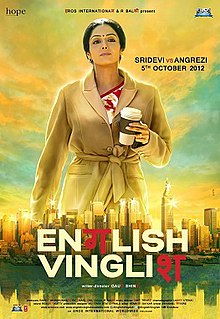
English Vinglish directed by Gauri Shinde

Source: Wikipedia
English Vinglish
India (Hindi), 2012
134 min, drama, comedy, family issues
Directed by Gauri Shinde

English Vinglish (2012) on IMDb


Shashi, a typical Indian housewife who runs a small sweet business out of her kitchen, finds herself belittled and ignored by her husband and daughter for her lack of English ability. When her Indian-American niece announces her plan to get married, Shashi is sent to New York City to help with the preparations. She is frightened because she has never travelled abroad, and she has no confidence in her ability to communicate in an English-speaking world.

After humiliation in a New York cafe, she decides to enroll in an English class with the money she had saved from her business. Part fish-out-of-water comedy, and part critique of women's place in society and the family, this movie demonstrates how people have the ability to learn and be more than they seem to be.

Watch the trailer: 

Buy on Amazon: