Friday, September 14, 2018

The Gilda Stories by Jewelle Gomez

The Gilda Stories
Jewelle Gomez
1991, I read 25th Anniversary edition, 2016
259 pages, speculative, LGBTQIA+
Found at Borderlands Books in San Francisco

Trigger warnings: rape, street harassment, blood, sex

I picked up this book on sale while visiting Borderlands Books in San Francisco this past winter. After spending so much time in India, where speculative fiction is not big and it can be hard to find anything beyond JRR Tolkein and Game of Thrones, Borderlands felt like paradise. I asked the staffperson to recommend some diverse books, since I did not usually have access to such a collection - and this is one of his recommendations. Thanks to Borderlands Books for recommending this book.

In this episodic novel, an escaped slave is rescued by two vampires who run a brothel together near New Orleans in 1850. When she chooses, they change her into a vampire as well. What follows is 200 years of exploration of herself, her found family, and what makes her human - or not. As a black woman living on the margins of society, how does she experience social changes over time? Where (or who) is home?

The best part of this book, for me, was the emphasis on creating a family. This is not just a romantic proposition, of finding one or more partners to live with over time; this group of vampires literally creates a family based on whether individuals want to join them and have the aptitude for living in a moral way. While some of these new family members might be brought in as lovers (i.e., the longest-running couple in the book, Sorel and Anthony), others are brothers, sisters, or friends. Lovers do not always stay together for long periods of time; according to their own wishes and interests, they go their separate ways, always knowing that they are part of a family that they can return to at any time. This vision of a found family is empowering: while they miss each other acutely, each individual's wishes and interests are respected, with the knowledge that they always have somewhere to come home.

Gilda's search for a family is also wrapped up in her search for a place. She constantly tries to create her own place of comfort and familiarity, even though she always knows that she will have to move again. Unlike other members of her family, she does not enjoy traveling - partially because of traumatic experiences in the past, and partially because she wants to enjoy staying in one place as long as possible. This is why she carries a collection of personal items with her through the years: she feels she can make a home for herself with her quilt, her desk, and some mementos of long-dead mortal friends and family. It is this vision of creating a home and a found family on the outermost margins of society that most appealed to me.

The fantastic aspects of this book were interesting. The vampires can move around - and even walk through daylight to some extent - if they just keep some of their native soil on their person at all times. They have creative ways of doing this: embedding some dirt into the soles of their shoes or in the hem of their clothes, for example. While they don't eat food, they do drink a lot of tea and alcohol, which seem to create them same effect as on humans. The most empowering is the idea of an exchange: for the blood they take, the vampires provide a solution to a problem that the human is worried about, or a happy thought, or something else that is good and useful for their mental lives. All in all, this is a unique take on vampires that brings this book beyond the somewhat standardized version we are familiar with from the last few decades.

I want to finish this review with a few words about my preconceptions about this book. In the cover blurb of the version I read, it states that, besides being a classic of lesbian literature, "The Gilda Stories has endured as an auspiciously prescient book in its explorations of blackness, radical ecology, re-definitions of family, and the erotic potential of the vampire story." If you read that last point and expect this novel to be full of erotica, you will be disappointed. While sexual activities (between women and one with a man) are poetically implied at numerous points, there are no explicit sex scenes in this book. [Trigger warning] There are a few mentions of rape or the threat of rape, as well as a number of scenes involving street harassment of various kinds. Similarly, there is not much explicit discussion of radical ecology: the environment mostly plays the role of a distant backdrop for the action, even when environmental collapse causes the breakdown of human society in the future chapters. This is mostly because of Gilda's lack of interest: she is happy with her own little sphere, and doesn't often bother with things outside of it. This is not true for the other vampires; Bird, for example, is constantly working as an environmental activist in various parts of the world. While I greatly enjoyed this book, I feel that it would have been better to not have these expectations going in.


Want to see more reviews of world literature and film? Follow me on Twitter or like The Globally Curious's facebook page!

Wednesday, January 3, 2018

Ruins by Achy Obejas

Ruins 
Achy Obejas
2009
205 pages, drama, character study
Found: A signed first edition (!) at a secondhand bookstore somewhere in India

Usnavy, a proud veteran of the Cuban revolution, is as much of a straight-shooter as it is possible to be. Despite the deprivations that have made life miserable for him and his family, he refuses to do anything illegal. The other employees at the bodega (government ration supply store) may sell products out of the back before they can be parceled out, but Usnavy refuses. He is happy to do the most miserable of government jobs - and be the one who gets abused about the lack of supplies or the need to collect funds for public projects - because he truly believes in his country and the purpose of the Revolution.

Where everyone else has given up, Usnavy continues to go on, an idealist till the end.

And then one of his best friends leaves the country by boat, and recruits Usnavy's help. And Usnavy is suddenly compromised for the first time. And suddenly Usnavy becomes truly aware of the deprivations and the ways he could make money to better himself and his family's position.

Hunger and food shortages


This book is best at getting you into the head of someone dealing with great deprivations, especially those caused by food shortages. There is no way that the government can provide enough food for people, so they are left to scrounge around for whatever they can find (or buy, or steal, or sell). Usnavy's constantly empty, rumbling stomach is an unceasing companion. The author conveys this all-consuming hunger so viscerally that I could feel my own stomach twisting as I read it:

Usnavy watched as [his wife] Lidia served up a sandwich for [their daughter] Nena that he recognized as having what looked like a reddish-brown meat. His immediate fear was that it was cat flesh. As a delighted Nena ate - complimenting Lidia, savoring the little bits of what looked like onions - Lidia kept busy, avoiding Usnavy's eye.... Of all people, of course, he knew that the only ingredient she'd gotten legally for that sandwich was the bread. (35)
But no sooner had Usnavy pulled up the bread and seen the flat layer of pith covered in seasoning, than he recognized its true provenance: These were pieces of a blanket normally used for mopping floors which [their neighbor] Rosita had beaten and marinated in spices and a little beef broth.... At least it wasn't cat meat, he thought. 
Then he bowed his head in dismay and disbelief. (37-8) 
What happens when basic necessities are only available on the black market, and you have to do illegal (and sometimes immoral) things to get the cash to pay for them? Especially if you believe so strongly in the rightness of the government and the society that you are a part of?

These are all moral questions that Usnavy struggles with in this book, and the constant hunger lends a sense of urgency and desperation to everything. What won't someone do when faced with such a situation?

Fear of flight


Usnavy spends much of the book trying to prevent his daughter from running away - from fleeing to the US, which beckons more and more with every day of starvation. It seems so close, and yet it is so far from everything that Usnavy ever wanted for her, or for them.

Usnavy has always been made fun of for being light-skinned, having red hair, and being so naive as to truly believe in the revolution. But he has also been fighting for the revolutionary values because he does not want things to change. He wants his struggle in the war to be worth something; he wants his country that he fought for to be worth something. And somewhere in his mind he worries that it is maybe not worth anything after all. What is the use of a country that can't even provide its own people with food to prevent starvation?

So he vehemently opposes the flood of people leaving the island for brighter shores, but also wonders when he will have to follow them. When he will himself turn traitor to the cause that he spent his life serving.

And of course that terrifies him.

Gender issues


I cannot write a review without examining the very delicate but incisive discussion of gender issues in this book. 

First, Usnavy's wife and daughter seem like women who have been forced to give up their desires for the sake of the man in their life (i.e., Usnavy). Lidia, Usnavy's wife, used to be a driver for a hospital, and, as Usnavy mentions, was "one of the first women to really excel at the job." However, due to budget cuts she was laid off and not provided with an alternative job that would pay appropriately. So now she is stuck in their tiny apartment, trying to eke out meals from the tiny amount of supplies that her husband brings home. 

Their daughter, Nena, is in a similarly stuck position. Not only will Usnavy not allow her to break any of the oppressive government rules, but she is stuck between school and home because he will not allow her to access his bicycle - not even as a loan! 

While Usnavy does give some thought to his family's position (especially in terms of hunger), his thoughts are mostly on himself. He never asks whether Lidia and Nena are ok with giving up opportunities to follow his principles. Usnavy spends most of his time outside of the house, whether at the bodega or playing dominoes with his friends; when he is not at home, he still takes up most of the space with his large stained-glass lamp (more on this below). It is a very claustrophobic situation for the two women, and there seems to be little thought on Usnavy's part about whether they really want a life like this.

Second, the novel masterfully details how relatively uneducated, ordinary people deal with trans issues. The "son" of one of Usnavy's friends is in the US, where "he" is reportedly doing well. When "he" comes to visit, however, it turns out that she has transitioned. While her father knew (and seems accepting), he had been ashamed to admit that his son was now a daughter. And his fear appears to be justified when another friend reacts violently to the news. But Usnavy does not seem to have a problem with the situation; sure, it is a bit unusual, but then as a kid she was always different. I would be very interested to hear the thoughts of a trans individual on this aspect of the book, particularly how they read Usnavy's reaction to her transition. 

A jeweled mystery


Usnavy's life is consumed by a large piece of his family heritage: a beautiful glass lamp that not only provides some comfort and beauty to his otherwise bare, meager life, but also inspires him to make changes to that life later in the novel.

To relieve the gloom, the family's room - a breadbox, a shoebox - was illuminated by a most extraordinary lamp. Were it not for the sheer size of it, Usnavy could have built a second floor - a barbacoa - like many of his neighbors. Made of multicolored stained glass and shaped like an oversized dome, the lamp was wild. Almost two meters across, the cupola dropped down with a mild green vine-and-leaf motif that flowered into luscious yellow and red blossoms, then became a crimson jungle with huge feline eyes. (In truth, they were peacock feathers, but Usnavy had never seen or dreamt of peacocks, so he imagined them as lions or, at least, cats.) The armature consisted of branches at the top, black and fat to resemble the density of tree bark. They narrowed as they neared the edge, until they were pencil thin and delicate. The borders were shaped with the unevenness of leaves and eyelids, petals and orbs, in a riotous yet precise design. (17)

This glorious lamp is the source of Usnavy's greatest joy. He knows it has something to do with his family's past; it was a feature at his mother's house in his childhood, but she had never explained its provenance or how it had come into their family's possession. He spends hours just looking at the lamp, polishing it, making sure it glows with all possible intensity. This obsession seems to take precedent over everything else in his life, including his family members.

It is only when a chance encounter shows him that there are other lamps like his (although smaller, less elaborate, not as beautiful) that he realizes he is sitting on a goldmine. He begins to use his knowledge of the lamp and its brothers to make some money, to improve the family's state of living. He sells the other lamps and the glass from the other lamps, but he is reluctant to touch his own unless absolutely desperate. And so he begins to walk a fine line: neglecting his official work in favor of an alternative industry of selling glass, while also refusing to allow anyone to see his own lamp. Eventually all of this has to catch up with him, somehow.

I absolutely loved this novel, and I cannot recommend it highly enough. It is both a good literary investigation of life in Cuba during the early years of the Special Period and a brilliantly written and paced novel.

Further Reading

"Was the 'Special Period' a Cuban Invention?" by Dmitri Prieto (Havana Times) 
"Cuba’s 'Special Period' Remembered" by Irina Pino (Havana Times) 
"The Maleconazo, Cuba’s First Popular Revolt, Happened 23 Years Ago" by Ivan Garcia (Translating Cuba)


Want to see more reviews of world literature and film? Follow me on Twitter or like The Globally Curious's facebook page!

Tuesday, August 15, 2017

Alif, directed by N K Muhammed Koya


Alif: The First Letter of Knowledge
India (Malayalam), 2015
101 min, drama
Directed by N K Muhammed Koya

This movie focuses on a Muslim family in Kerala, India, which had been important in the past but had fallen out of power because of the death of the patriarch. At this point there are four generations living together from this one family. For simplicity’s sake I will refer to them as the grandmother, the mother, the daughter, and the granddaughter. There is also a grandson who is younger than the granddaughter, and who is the pride and joy of this otherwise poor family.

The plot of the movie concerns these four generations of women and how they deal with the patriarchal Muslim and Malayali society that they live in. They have to realize their own autonomy while still being circumscribed by the men in their lives, specifically the dead grandfather and the young boy.


Social ostracism


At the very beginning of the movie, the daughter is summarily divorced by her husband with the support of some village elders. Even before this, he had not been contributing to the family, and they were suffering because of this.  Not only are they having trouble because of not being able to afford food, etc., but they are treated badly by the other members of the community because of their poverty. For example, when the grandson visits a friend from a wealthier house he is forced to sit on the floor to watch TV; he is not allowed to sit on the furniture.

Read the rest of this review at The Asian Cinema Blog


Further Reading: 

"Understanding triple talaq (and domestic violence) through the stories of three Muslim women" by Aarefa Johari (scroll)


Want to see more reviews of world literature and film? Follow me on Twitter or like The Globally Curious's facebook page!

Tuesday, April 11, 2017

Moogavani Pillanagrovi (Ballad of Ontillu) by Kesava Reddy, translated by the author

Moogavani Pillanagrovi (Ballad of Ontillu)
Kesava Reddy
Translated by the author (Telugu)
First published 1993, I read 2013 translation
114 pages, common man's tragedy, mental illness

Many thanks to Oxford University Press India for providing a review copy of this book.

After being forced to sell his land, an elderly farmer faces a mental breakdown that finally ends in his death.

This is my first video review! Watch it here:


References: 

Accidental Deaths and Suicides in India 2014 (National Crime Records Bureau)
"Centre must step in to stop farmer suicide, Madras HC says" by A Subramanil (Times of India)


Further reading:


"Why Farmers are Protesting with Human Skulls at Jantar Mantar" (thewire.in) (video)
"BJP ignoring farmer suicides by pushing for stricter cow slaughter laws: Sena" (Hindustan Times)
"West Bengal: Potato farmers commit suicide even after bumper harvest" by Indrajit Kundu (India Today)
"India's sugarcane farmers: A cycle of debt and suicide" by Janos Chiala (Al Jazeera)
"Stories of survival: Widows of India's farmer suicides" by Deepti Asthana (Al Jazeera)
"Why Bihar Sees Fewer Farmer Suicides Than More Developed States" by Sanjiv Phansalkar (Huffington Post India)


Want to see more reviews of world literature and film? Follow me on Twitter or like The Globally Curious's facebook page! And don't forget to subscribe to my Youtube channel for more videos! 

Thursday, March 16, 2017

Behind the Painting and Other Stories by Siburapha, translated by David Smyth

Behind the Painting and Other Stories
Siburapha (Kulap Saipradit), 1905-1974
Translated by David Smyth (Thai)
Translation first published 1995, I read 2000 Silkworm edition
160 pages, psychological drama, romance, plight of the poor

Many thanks to Silkworm Books for providing a review copy of this book. 

Behind the Painting is Siburapha’s most acclaimed novel, a tale of the repressed romantic feelings between a young Thai student studying in Japan and an older, married Thai woman on holiday there. According to the introduction, this novel is the best example of  Siburapha’s early writing: romantic stories based on the upper classes of Thai society during the interwar period.

His later stories, however, draw upon his Communist politics to portray the plight of the poor and working classes. The three short stories in this collection provide a sample of his later work, which contrasts with the novel in almost every way. Because of these differences, I will review the novel and the stories individually.

Behind the Painting (serialized 1937-1938)


When an elderly member of the Thai nobility contacts him, the young Thai student Nopphon agrees to arrange their travels in Japan, where he is studying. The elderly man is accompanied by his younger wife, Mom Ratchawong Kirati, and Nopphon’s quick friendship with her soon blossoms into love. When he reveals this to her, she refuses to respond in kind and requests that he hide his feelings. However, it is evident that her actions are bound by her difficult circumstances - and therein lies the essential tragedy of this short novel.

There are several important cultural insights that can be gleaned from this beautifully written novel. First, Mom Ratchawong Kirati is stuck between a rock and a hard place: she feels like she must preserve her looks to be liked in the society; at the same time, she is prevented from going out into society because of her rank as a member of the nobility. At this time, nobles were required to act in specified ways that marked their difference from the peasantry - they were not allowed to pursue certain careers, interact with certain lower-class people, travel to certain places or in certain ways, and so on. (I will discuss this further in my forthcoming review of Many Lives by Kukrit Pramoj.) These restrictions and enforced isolation from society prevent her from living as she desires, and prevent her from even looking for love. This leads her to agree to marry a man who is significantly older than her, whom she does not love and who does not love her.

Sunday, February 12, 2017

Dangal, directed by Nitesh Tiwari

Dangal
India (Hindi), 2016
161 min, sports movie, biography
Directed by Nitesh Tiwari
Starring Aamir Khan, Fatima Sana Sheikh/Zaira Wasim, Sanya Malhotra/Suhani Bhatnagar

After he is forced by financial circumstances to give up his own wrestling career, Mahavir Singh Phogat plans to train his future son(s) so that they will win a gold medal for India on the international stage. When he ends up having four daughters, he thinks his dream is lost – but then he has the radical idea that girls can be wrestlers, too. After many years of intense training, he manages to bring two of his daughters, Geeta and Babita, to the international level. But will his old-fashioned, village methods work against athletes from around the world?

This movie tells the true story of Geeta Phogat, the first Indian woman wrestler to win a gold medal at the Commonwealth games (in 2010), her sister Babita Kumari, also a gold medalist, and their father who coached them to greatness.


The Cultural Context


This film does a good job of showing the cultural context and why, exactly, this family is so remarkable. Mahavir and his family live in a village in rural Haryana, India – a state known for its poor treatment of girls, and high rates of female infanticide. Haryana has one of the worst sex ratios of any Indian state: 861 women for every 1000 men in the whole population, and 835 girls for every 1000 boys aged 0-6 years. Patriarchy, especially the wish for male children to carry on one’s legacy, is particularly strong. The movie demonstrates this cultural pressure for male heirs through a humorous sequence, in which Mahavir receives innumerable bits of advice on how to conceive a male child. In the end, it seems to be a catastrophe for the entire village when all of these efforts fail and Mahavir’s wife continues to have girls.

Read the rest on the Asian Cinema Blog


Want to see more reviews of world literature and film? Follow me on Twitter or like The Globally Curious's facebook page!

Friday, January 13, 2017

Bale Bale Magadivoy, directed by Maruthi Dasari

Bale Bale Magadivoy
India (Telugu), 2015
137 min, romantic comedy
Directed by Maruthi Dasari
Starring Nani and Lavanya Tripathi

Lucky is a young, good-hearted plant scientist with one major flaw: a mental disorder that makes him get distracted incredibly easily. This interferes with his life in various ways, and now it is interfering with his ability to find a girl and get married. When his father arranges for Lucky to meet the father of a prospective bride, Lucky gets distracted by a series of random events in full view of his prospective father-in-law – leading him to believe that Lucky is a terrible human being.

When Lucky accidentally runs into the girl, Nandana, he falls in love and tries to conceal his problem of forgetting everything. Many of his actions turn into (or are passed off as) incredible philanthropy, and Nandana falls in love with him partially because of his apparent goodness. But how long can he keep this up? Will he ever get the girl?


Disability


Lucky’s habit of forgetting things is treated as a disability throughout the film – and not just because he thinks he has to hide it. Throughout his life, his father has told him that he will never amount to anything, or be able to get married, because of his forgetfulness. And it does significantly impact his life - he has trouble carrying out the simplest tasks because he forgets about them halfway, and he has a lot of trouble with accidentally giving away his belongings – including his father’s car!

Thursday, January 5, 2017

Jeevichirikkunnavarkku Vendiyulla Oppees (Requiem for the Living) by Johny Miranda, translated by Sajai Jose

Jeevichirikkunnavarkku Vendiyulla Oppees
Requiem for the Living 
Johny Miranda
Translated by Sajai Jose (Malayalam)
2013
87 pages, ethnography, family drama

Thank you to Oxford University Press, India for providing a review copy of this book. This is part of the Oxford India Novellas series, which translates short works from Indian languages into English. 


An oppees is a prayer for the dead. This novella tells the story of a people who are eligible for an oppees in every way, while yet alive. - Author's Note

Josy (Osha) Pereira is the latest in a line of church sacristans in a village near Kochi, Kerala. His family belongs to the Parankis - a Christian group with mixed bloodlines due to centuries of Portuguese rule and trade in the area.

In a winding narrative, Osha tries to explain his life to the reader: his grandmother Mammanji's almost magical religious/traditional healing abilities; his father's desertion of the family in order to go on pilgrimage; his own hapless marriage and inability to connect with his wife; and, most importantly, his unique community and the religious and cultural values that it reveres.

Women and Men


As noted by J. Devika in her fantastic introduction, one of the central issues in Osha's story is the struggle between men and women in this community, and in Kerala as a whole. While Kerala is widely regarded as one of India's most developed and progressive states - with the highest rate of female literacy in the country and a higher percentage of women in the population than men - the actual story is much more complex. Keralite women do work outside of the home, and many have jobs that are considered "man's work" in the rest of India. Historically, several of the ruling groups have also been matrilineal, tracing their lineage through the female line and placing the elderly women in the family in a position of great power (but limited mobility).

Perhaps related to this history of female power and (limited) autonomy, Keralite society brims with an existential crisis of masculinity. This is reflected in many ways: restrictions on women's movement and strict gender separation in some public places and transportation; high rates of crimes against women; and a tendency toward machismo on the part of men, who feel that they must prove their manhood. This last aspect (expressed primarily through the need to be right at all times, even if demonstrably wrong) that has been particularly pronounced in my dealings with Keralites during the year I lived in a village near Kochi.

This novella does a great job of depicting these ideas and attitudes. Osha's life is dominated by powerful and influential women, and he does not know how to deal with this. He feels emasculated: why does he have to rely on his mother or grandmother, and why are his male relatives so ineffectual in comparison to them? Osha's existential angst, which he treats with alcohol and laziness, highlights this major problem in Keralite society.

Ethnographic Details


This novella is unique in that it is written by a member of the Paranki community from Kochi, a forgotten and marginalized group that does not fit into Kerala's highly stratified and purity-conscious society. As the translator notes in his introduction, much of the culture depicted in the novel is unfamiliar even for Malayalam readers: the "extremely local references" to Kochi Creole/Paranki culture and religion call for a detailed glossary of terms and rituals, provided at the end of the book. 

Osha also seems to be aware of how marginal his community is; he often stops to explain the significance of various rituals, terms, or clothing. This adds an additional flavor to the narrative: he is evidently addressing someone outside of his group, and wants to reveal something about his heritage and life. Luckily for the reader, this provides a detailed look at this fascinating religious, cultural, and ethnic minority, the history of which is further elucidated in J. Devika's introduction. 

While I did not like this story, per se, I do recommend this novella for the ethnographic information it provides about Keralite society and this particular community. If you are at all interested in cultural mixing, Indian Christians, or minority communities, I highly recommend this book. 


Further Reading: 


"Tribute to Cochin Creole Portuguese," an interview with Dr. Hugo Canelas Cardoso by K. Pradeep (The Hindu)
"What Led to the Decline of the Matrilineal Society in Kerala?" by Sheryl Sebastian (Feminism in India)


Want to see more reviews of world literature and film? Follow me on Twitter or like The Globally Curious's facebook page!

Monday, January 2, 2017

Mini Review: "Egg" by Priya Sharma

Fantasy, horror
July/August 2016

This is the first of what I call "Mini Reviews:" short reviews of short stories by diverse authors that are (usually) available for free online. My New Year's Resolution is to post two of these Mini Reviews per month in 2017, in addition to the usual long post per week. Wish me luck! 

After failing for years, a woman will do anything to have a child. An old hag offers her the opportunity to do so – if she is willing to face the consequences. All of the consequences.

This story considers two interconnected issues. First, the significance of having a child of one’s own, especially for women. The narrator is willing to go to any length to have her own child, and will not even consider adoption. Is this because of the social pressure to have a child? Or because of some deep, internal yearning? Some combination of the two? The source of this desire is unclear, but it comes through strongly in this narrative.

And second, the difficulties of having a child with special needs. To care for her child, Chick, the narrator needs to do things she would never have considered. Just one example is that Chick will not breastfeed; instead, she will only eat worms that have been chewed up and placed in her mouth! Despite her disgust, the narrator puts the child’s needs before her own and does what is needed. However, this puts an immense strain on her, especially after Chick fails to grow and is unable to show any affection. Is all of this care worth it if she never receives anything in return?

You can read the story for free online here. I'd love to hear your thoughts below.


Want to see more reviews of world literature and film? Follow me on Twitter or like The Globally Curious's facebook page!

Saturday, December 31, 2016

Year in Review: 2016

This year was bad. Really bad.

That's why I put off writing this post. Who really wants to revisit such a bad year?

But then I thought it would be a disservice to the really good books I read and movies I saw this year. So this is for you, the authors, directors, actors, and other artists who created these works.

In no particular order, these are the novels I enjoyed this year:


Sorcerer to the Crown by Zen Cho (review forthcoming)


Rosewater by Tade Thompson (review forthcoming)


Labyrinth Lost by Zoraida Córdova


Hurma by Ali Al-Muqri, translated by T.M. Aplin


The diverse movies I enjoyed this year:


Adaminte Makan Abu, directed by Salim Ahmed (2011) (review forthcoming)


Neerja, directed by Ram Madhvani (2016)


Sardaarji, directed by Rohit Jugraj (2015)


Te3n, directed by Ribhu Dasgupta (2016) (review forthcoming)

As you can see, for lots of reasons I have been unable to review as much as I would have liked this year. Here's hoping for a somewhat more settled 2017. 


Want to see more articles like this? Follow me on twitter or like The Globally Curious on Facebook. 


Thursday, December 22, 2016

Labyrinth Lost by Zoraida Córdova

Labyrinth Lost
Zoraida Córdova
2016, I read digital review copy
336 pages, YA fantasy, LGBTQIA+

Many thanks to Sourcebooks Fire for providing a review copy of this book! 

Alejandra, or Alex, is a bruja, one of a long line of magical people. While her family is all-important, she’s hiding a secret from them: she does not want to be a bruja. When she tries to escape from her power and ends up sending her family into exile in an alternative realm, it’s up to her, her hired guide Nova, and her human best friend Rishi to save her family and the magical realm of Los Lagos.

Highlight the black sections to reveal spoilers.


Latinx Culture, Religion, and Magic


One of my favorite parts of this novel was the worldbuilding. Set in contemporary Brooklyn, the brujas are both very much a part of New York society and a secretive group that follows different laws. While they perform seances and healing sessions, they still have to pay the bills. The best example of this is Alex's mother, who has healing powers but also works in a gynecologist's office - as a secretary. This made me question why she never went into medicine herself; my guess is that her family did not have enough money to afford medical school. This indicates that the bruja community is very much subject to the same restrictions and racial/income discriminations that others experience, including Latinx communities.

Where do the brujas get their magic? It seems that it comes from two sources. First, their own families, living and dead. The importance of family - the full, extended, complicated and difficult family - is emphasized throughout this book. Despite fighting with her sisters (like everyone does), Alex is fiercely loyal and protective of them. Her decision to remove her own magic is a misguided attempt to protect her family from what she can do; when she accidentally banishes them to Los Lagos, she is wracked with intense guilt for what she sees as her betrayal of the ones she loves.

What Alex does not realize at first is that much of her power comes from her family - both from her long lineage and from the love that her family has for her. Setting aside the magical aspect for a moment, this is an incredibly powerful statement: your family's love for you can give you the strength to do things that you would never be able to do on your own.

On the other hand, in Nova we see the flip side of this importance of family among the brujas. Nova does not have a family, as such: he was abandoned and abused by his remaining relatives. This results in his inability to have a Deathday, and therefore his inability to contain and control his power - which is slowly killing him. Nova's abandonment is not his fault, but in this world - both among the brujas and in human society - he is punished for it.

The second source of bruja magic is their religion, a polytheistic and ancestor-worship belief system inspired by the veneration of saints in Latin American Roman Catholicism, Day of the Dead, and Santería. In addition to revering departed members of their family, brujas worship numerous deities named after natural elements - El Fuego, La Ola, etc. - who bless them with magical powers. The worship of these gods is complex, involving personal altars, offerings, prayers, and spells.

Cordova takes time to flesh out these religious practices: Alex compares her relatively unkempt altar with those kept by her family members, for example. The images and offerings on each person's altar indicate their values and powers. Since each deity grants a specific type of magical ability, each person generally prays to the deity associated with their power. The level of detail provided for these religious practices indicates just how intimately intertwined they are with the daily life of the brujas.

One other thing that I wanted to note is that bruja society is matriarchal: the women are the ones who are usually most powerful and who make most of the decisions. This is quite refreshing.

Positive bisexuality


Another thing that this book does really well is representing bisexuality in a positive way. From the very beginning of the novel, we are introduced to Alex’s as-yet-undiscovered feelings towards her human best friend Rishi. Then she also starts to fall for the hunky and mysterious Nova. Both of these relationships felt like equally valid possibilities.

Importantly, Alex's family is also supportive of queer relationships. This is first indicated by another lesbian relationship in her family (in an older generation), and then by the way her family acts when she finally chooses Rishi. Not only does this book provide an excellent example of bisexual attraction, but it shows a positive response from the main character's strong family unit.

I loved this book for its mythology, its characters, and its worldbuilding. If you haven't read it yet, go read it now.

Want to see more reviews of world literature and film? Follow me on Twitter or like The Globally Curious's facebook page!

Friday, December 16, 2016

Two Webcomics: A Redtail's Dream and Anu-Anulan & Yir's Daughter

Today I'm going to do something a little different and review two webcomics that I recently finished. Both are complete stories that combine fantasy and mythology in a unique way, with gorgeous artwork.

A Redtail's Dream


Minna Sundberg
Finnish and English
Completed, 2011-2013
556 pages, fantasy, boy and his dog

When the residents of a village in rural Finland are accidentally sent into the Realm of Dreams (by the Puppy-fox Spirit, who is left in charge while his elders have a meeting), the loner Hannu and his friendly dog Ville must perform tasks to release their friends and neighbors. 

The story is broken into chapters. In each one, Hannu and Ville find themselves in a different part of the realm of dreams, where they must complete a random task to convince the main villager in that area to return home (and take the others with them). Each main villager is accompanied by an ancient animal spirit; Ville, to his delight and sometimes dismay, takes the same form as the animal spirit while they are there. Hence you have a dog that becomes everything from a squirrel to a moose to a seal. 

And did I mention that Ville can talk?

According to everything I have read, this tale draws heavily on Finnish mythology. Puppy-fox is a classic trickster character, Hannu and Ville's tasks feel like something from a folktale, and so on. However, I was unable to find a detailed breakdown of the mythological elements of this work online. Perhaps it is so close to the original tales that it isn't worth analyzing? I would love to read an in-depth article on the similarities and differences to the myths. 

Most importantly, the art of this webcomic is absolutely stunning. It is well worth reading just for the beauty of it. 


Further Reading: 

"Finnish Mythology" by Molly Kalafut
Read The Kalevala from Sacred Texts

Anu-Anulan & Yir's Daughter


Emily Carroll
English
Completed, 2011
3 pages, fantasy, LGBTQIA+

In this very short comic, the goddess Anu-Anulan requests a woman (Yir's daughter)'s bright, silvery hair. But after she receives it, she realizes something is missing. 

I am not sure if Anu-Anulan is based on any particular deity. Rather, Carroll uses mythlike storytelling to convey a very sweet tale. 

The artwork used for this story is relatively simple, but incredibly expressive. It's only three pages - go read it now! 

Want to see more articles like this? Follow me on twitter or like The Globally Curious on Facebook. 


Thursday, December 8, 2016

Queen, directed by Vikas Bahl

Queen
India (Hindi), 2013
146 min, comedy, self-exploration, travel
Directed by Vikas Bahl
Starring Kangana Ranaut

When Rani’s fiancée breaks up with her two days before their wedding, she decides to go on the honeymoon by herself. Her first time outside the country, and her first time really alone, gives her the opportunity to explore who she is and what she wants from life.

While in many ways this film draws upon problematic stereotypes of “life in the West,” it still provides a good example of a sheltered young woman steering her own life for the first time.

Self-exploration


In Delhi, Rani lives a sheltered and protected life. Her younger brother acts as her chaperone, especially when she meets Vijay, her fiancée. It seems like her match with Vijay was only partially of her own accord: she wanted an arranged marriage, and this marriage seems to be half-arranged. I’m not sure she really considered any alternatives before making the decision, since she just took marriage as a matter of course.

When Vijay dumps her, she is devastated. She curls up in a ball and cries in her room for a whole day. But she emerges with a decision: she was really looking forward to going to Paris, and had even spent all of her life savings on the ticket – so she wants to go. At this point, she still gives her parents the veto decision, but her father realizes that she needs to do this for herself. Hesitantly, they drive her to the airport and send her on an adventure without them.

At first Rani is incredibly overwhelmed, lonely, and just wants to go home, but then she makes friends and begins to enjoy herself. As she does so, she realizes that she doesn’t need a man to have fun or to travel. She also realizes that some of the assumptions she was making about other people were wrong. For example, although she has been taught that all men are scary, she ends up befriending her three male roommates at a hostel in Amsterdam. Over the course of the film, as she continues to try new things, she becomes less afraid and more independent.

The Indian jerk boyfriend


This film directly addresses one of my pet peeves about Indian movies: the valorization of abusive (even stalker!) boyfriends. After Vijay dumps her suddenly, with no thought about her feelings, Rani accidentally sends him a picture. Seeing this selfie, Vijay suddenly realizes that he actually still loves her. He begins calling her repeatedly, and even goes to Paris and then Amsterdam to track her down.

At first, Rani doesn’t know what to do about this. She is angry, but society has taught her that she should forgive him. When he suddenly appears in Amsterdam, she is willing to talk to him privately - even after he tries to beat up one of her new friends in a fit of over-possessive stupidity! Finally, at the end of the film she realizes that his behavior is not acceptable and that he does not deserve her.

I was happy that Rani, unlike many Bollywood heroines, comes to the realization that stalking and over-possessive behavior is not romantic.

Buying into stereotypes of the West


My biggest problem with this film is the incredibly stereotypical depiction of the West. As usual, Rani’s character exploration is accompanied by large amounts of drinking, clubbing, and visiting red light areas (in Amsterdam, of course). Like other films of this genre, it seems like the only way Rani can loosen up is by literally wearing less clothes and drinking. Obviously, this isn’t all that happens in the West – but if you watch Indian movies you would be forgiven for thinking so.

Rani has two potential love interests in Amsterdam, one an Italian restaurant owner and the other one of her roommates. Of the three roommates, the one who catches her eye is the only white person; the others are a black Frenchman and a small Japanese man. The depiction of the Japanese character fits into the racist depiction of Asian men as cute but sexually unattractive; the Black character has barely any speaking lines. It is the hot, emotional, artistic, very white Russian who catches her eye. This reinforces the idea that the only foreigners worth dating or marrying are white people – an idea that is quite prevalent in Indian society.

Despite these rather significant problems, the powerful portrayal of Rani’s voyage of self-discovery makes this movie worth watching. I recommend it as an exploration of how being alone teaches you about who you really are.


Want to see more reviews of world literature and film? Follow me on Twitter or like The Globally Curious's facebook page!

Thursday, December 1, 2016

Islamicates: Volume I, edited by Muhammad Aurangzeb Ahmad

Islamicates: Volume I
Anthology of Science Fiction short stories inspired from Muslim Cultures
Edited by Muhammad Aurangzeb Ahmad
2016, available for free here
236 pages, speculative

Personal note: 

It seems appropriate that my first post after the election concerns a book inspired by Islam and Islamic cultures. Among the many, many evils that have been drawn out of the woodwork by the new president-elect's policies, I am the most worried about the marked increase in Islamophobia. 

This freely available book presents many different perspectives on Islamic people and societies. In some stories, religion is outlawed and people must fight to continue following their beliefs. In others, religion is the problem that people are fighting against. But in all of them, Muslims are shown as they truly are: people trying to make their way in the world, fighting against circumstances outside of their control, just like everyone else. Many of these stories draw upon events that are currently happening: the war in Syria, the Refugee Crisis. Some reverse the flow of migration so that Europeans become the migrant workers. All of them speak to parts of Islamic society that many people in the West are unaware of. 

I encourage everyone to read through some of the stories in this collection, and to share them with friends who might have doubts about this religion and the people who follow it. At this historical moment more than ever, I consider it a moral duty to spread diverse literature in order to combat the prejudices, xenophobia, and, yes, White supremacy that is growing like a cancer in many parts of the world. Please join me by supporting works that combat stereotypes about People of Color and other minorities. 

In this collection published by the excellent website Islam and Science Fiction, authors from around the world have created science fiction short stories inspired by Islamic cultures. The works presented are the 12 best of those submitted for the first Islamicate Short Story contest run by the same website.

Since there are so many stories, I will only provide an analysis of the ones that really spoke to me. However, I highly encourage you to read the others as well.

“Calligraphy” by Alex Kreis (USA)


After a rivalry between two tile makers turns dark, the remaining one laments his actions.

This story uses the formal and slightly stilted language of Victorian translations from Arabic, which I quite enjoyed. Unlike the rest of the stories in this collection, it is set in the past. On the first reading I was confused about its inclusion in this collection, since it didn't seem very much like science fiction. But then it struck me that it taps into the history of scientific exploration and discovery in the Muslim world during the medieval period. The narrator sees something that he does not understand, but which was created through advanced scientific and artistic skills, and voila: a fascinating science fiction story set in the past.

“Insha’allah” by R.F. Dunham (USA)


It seems like a normal state of affairs - an adult child is more comfortable with a new technology than her parent is - but in this case the technology allows one to know the future, and the father Khafid is the inventor who has since forsworn his creation.

This story deals with the lack of intergenerational communication that can happen based on the life experiences of older family members, as well as whether all inventions are necessary. What criteria would make a technology bad (not evil, just extremely misguided)? After much reflection, Khafid has decided that his invention was a bad idea for several reasons, not least because of his faith, but he has trouble expressing that to his daughter in a way she would understand. Anyway, his daughter refuses to listen and has instead decided to improve the device by increasing its temporal range. As you can probably guess, this is a bad idea.

Wednesday, November 2, 2016

Ajjiit: Dark Dreams of the Ancient Arctic by Sean A. Tinsley and Rachel A. Qitsualik

Ajjiit: Dark Dreams of the Ancient Arctic
Sean A. Tinsley and Rachel A. Qitsualik
Illustrated by Andrew Trabbold
2011
191 pages, speculative fiction, indigenous

Many thanks to Inhabit Media for providing a review copy of this book, and to my mother for sending it to India as a Christmas present last year! 

This collection includes nine innovative speculative fiction stories that are inspired by traditional Inuit society and folklore.
To a degree, our point, in crafting these fantasy stories, was to draw upon Inuit culture and lore, writing original fiction utilizing the unique creatures and concepts that Inuit once (and, in some cases still do) fear or revere [sic]. Our main purpose, however, was to illustrate a sort of cosmological thinking particular to Inuit culture - a mystic tradition, if you will, that is not unlike the Arctic itself: barren to the superficial eye, yet filled with riches for those willing to fix a deep and non-judgemental stare. - Authors' introduction

“Elder”


Pigliq, one of the Humble Folk, is a poor sleeper – he can’t fall asleep properly, and his friend has to dream clothes for him. This leads to ridicule and complaints. But when his people awake from their latest slumber to find a terrifying new threat, it’s up to Pigliq to save them all.

Besides tapping into a fantastically unique race of humanoid beings from Inuit mythology, Pigliq’s unique plight – not being able to sleep, and therefore to dream – is compelling. He is considered disabled and is bullied for his differences from his peers, but in the end his "disability" is what allows him to fight when no one else can.

“The Qallupiluq Forgiven”


The Qallupiluq is a terrifying shapeshifter from Inuit mythology, who has the prerogative to kidnap and eat anyone who says its name.

This story was one of my favorites in Moonshot: The Indigenous Comics Anthology Vol. I.

Monday, October 24, 2016

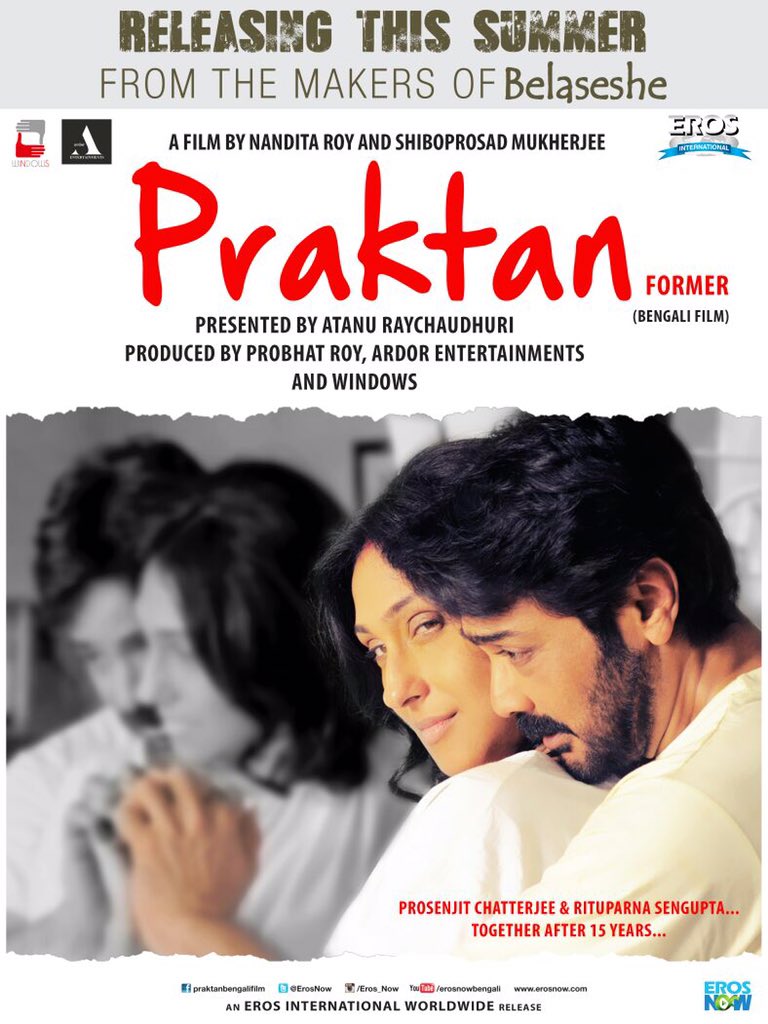
Praktan, directed by Nandita Roy and Shiboprosad Mukherjee

Praktan
India (Bengali), 2016
143 min, drama
Directed by Nandita Roy and Shiboprosad Mukherjee
Starring Rituparna Sengupta, Aparajita Auddy, and Prosenjit Chatterjee

Content Warning: Discussion of Emotional and Physical Abuse

Ten years ago, Sudipa and Ujaan divorced after a difficult marriage. Today, Sudipa finds herself in a first-class train carriage from Mumbai to Kolkata with Malini, Ujaan’s new wife, and their daughter. During the course of the two-night train journey, Sudipa finally deals with the pain from years before.

Meanwhile, we see the stories of people in other rooms in the same carriage. Four famous Bengali musicians (Surojit Chatterjee, Anindya Chatterjee, Upal Sengupta, and Anupam Roy, playing themselves) serenade each other with new compositions. An elderly couple returns from Mumbai after seeing their son off to the US. And last but not least, a couple of newlyweds put the trip in a private cabin to good use.

Both an intimate story of pain, heartbreak, and healing, and a glance at the things that happen in first class, this is a new, great train movie from West Bengal. However, the ending left a bad taste in my mouth.

Thursday, October 20, 2016

Blackass by A. Igoni Barrett

Blackass
A. Igoni Barrett
2015, I read PDF review copy
304 pages, social satire, speculative

Many thanks to Kachifo Limited for providing a review copy of this novel. 

Furo Wariboko awoke this morning to find that dreams can lose their way and turn up on the wrong side of sleep. He was lying nude in bed, and when he raised his head a fraction, he could see his alabaster belly, and his pale legs beyond, covered with fuzz that glinted bronze in the cold daylight pouring in through the open window…. His hands were not black but white… same as his legs, his belly, all of him.

Thus begins this Kafkaesque satire about race relations in Nigeria. Furo wakes on the morning of a big job interview to find that he has suddenly turned White – complete with red hair and blue eyes. Escaping from his house, he turns up at the job interview and, as a White man, finds that not only his job prospects, but every other aspect of his life has significantly improved.

Being White in a post-colonial society


Furo encounters all of the things that I, myself, have experienced or witnessed as a White person living in a post-colonial society (in my case India). Using the same qualifications that had lost him numerous opportunities in the past, as a White man he is immediately offered a good job. People trust him enough to give him money within two minutes of meeting him.

He also receives intense stares everywhere he goes:
Lone white face in a sea of black, Furo learned fast. To walk with his shoulders up and his steps steady. To keep his gaze lowered and his face blank. To ignore the fixed stares, the pointed whispers, the blatant curiosity. And he learnt how it felt to be seen as a freak: exposed to wonder, invisible to comprehension.
As a White man, Furo is expected to act a certain way; when he doesn’t fulfill people’s expectations they become surprised and start to question him. When he tries to eat in a roadside restaurant, for example, people stare and ask why he is there. To escape the stares, he goes into one of the city's fancy shopping malls (which he has never previously entered), and fakes casualness while drinking an incredibly expensive coffee. As a White person, he is not only expected to have a lot of money, but also to fit naturally into high society.

Tuesday, September 27, 2016

In Memorium: Parthasarathi Neogi


My father-in-law, Parthasarathi Neogi, died suddenly last Friday night, September 23, 2016. After a day spent visiting old friends, he had a sudden stroke and died within a few minutes.

My husband Tintin and I were in Kerala, and were woken up at 11 PM by a phone call from his mom. We flew home on the first flight at 5:30 AM, and completed the funeral by that evening. We just finished the last of the rituals to give him peace.

I called him Baba, the Bengali word for father.

I couldn't have asked for a better father-in-law; he truly loved me. He would do small things to show his love, such as bring big chocolate bars to have on hand whenever I came. I was supposed to come to Kolkata (alone) on October 12th, and he had offered to pick me up from the airport. He had also, I discovered when I came, bought three new bedsheets for me to use while I was here.

These may sound like very small things, but when put together they added up to a very good man who loved me very much. And I miss him.

I will be in Kolkata for the next few months to take care of affairs while Tintin returns to Kerala for work. It will be hard to be separated for such a long time, but it is necessary right now.


Rest in Peace 

Friday, September 23, 2016

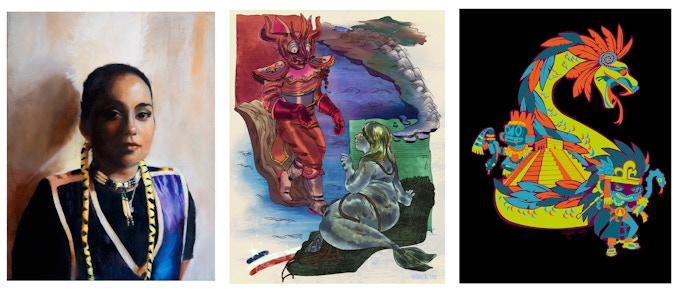
Kickstart These: La Raza, Moonshot Vol. II

There are two excellent, diverse comic anthologies waiting for funding on Kickstarter right now.

La Raza Anthology: Unidos y Fuertes


A collection of comics by Latinx creators! Pledges start at US $2, and you can get a copy of the book for $15(ebook)/$25(hardcopy).

I love the artwork.
The last day to pledge is September 29, 2016.

Moonshot: The Indigenous Comics Collection, Vol. 2


I loved the first volume of this series of comics by Native American artists, mostly from Canada. You can read my review here. The second volume promises more of the same excellent work. In fact, 
Each of the 15 short stories included in this c.200 page Volume will be based on a tradition from the author's own tribe/community. These stories highlight present-day traditions, and diversity, in indigenous peoples today.
 As always, the artwork looks absolutely breathtaking, and you can get prints as a backer award.

Pledges start at $5 CAD, and you can get a copy of the book for $10(ebook)/$20(hardcopy). 

The last day to pledge is September 30, 2016. 


Go get your copies before time runs out! 

Want to see more articles like this? Follow me on twitter or like The Globally Curious on Facebook. 

Thursday, September 22, 2016

The Timehrian by Andrew Jefferson-Miles

The Timehrian
Andrew Jefferson-Miles
2002
110 pages, post-modern, speculative

Thank you to Peepal Tree Press for providing a review copy of this book. 

After awaking from a six-year madness, Leon-Battista Mondaal writes to his cousin in an attempt to express what he has experienced. The result is this poetic novel that can never tell a straight story, but nevertheless reaches toward the truth - of Guyana’s colonial and post-colonial past, of ethnographic practice, and of the relationships between people.

This book is essentially a prose poem, for better or for worse. At times, it becomes almost incomprehensible, such as:

The tidal wave that swept all away possessed a sort of hybrid vigour that reached over our best attempts at correction. It exhibited an evenhanded kind of intervention in our affairs, entangling and suborning layers and institutions and environments. Former legacies are converted into new bodies whilst old shapes enter the squall and masquerade of memory, whose disguises enact majestic instability in our conception of ourselves. It is a complex, a charged phenomenology of practice and custom intensifying communities diverse in their origins, orientations, dictions.

I don’t usually enjoy reading poetry, but I will try my best to pull out what I understood from this text.

Colonialism and ethnography


Immediately before the tidal wave that caused Leon-Battista’s descent into madness, he was working with an ethnographic team recording the traditional Christmas masquerade in a Guyanese coastal village. However, he seems to be uncomfortable with the whole process, and especially with the functionalist and colonial attitude of Laban, the group’s leader and a renowned anthropologist.

Part of what Leon-Battista points out is a common critique of early forms of anthropology (before the “reflexive turn”). As he notes,

Conventional epistemes for the study of man (social relativism in anthropology, ethnolology, ethnography) tend to benefit least those about whom the study is made. Those about whom the study is made rarely get to participate in it. 

As a discipline, anthropology now recognizes these issues and does its best to rectify them (or at least to be aware of them and their effects on a study) through participative modes of ethnography and research.

However, it seems that Leon-Battista is also referring to the colonial attitudes of some ethnographers, who treat the people they study as a way to produce knowledge, nothing more. Laban is a “native anthropologist:” originally from Guyana, he has returned as a celebrated academic to study his “native” culture. Despite this apparent belonging, he still treats his research participants as subjects of study rather than real, three-dimensional people.

History 


Another issue that Leon-Battista brings out is the complicated history of the area, from both an ecological and cultural standpoint. Apart from the colonists that came from Europe, the people in the area are also the descendants of African slaves, Indian indentured servants, and the Amerindian inhabitants of the area. As all of these groups have combined to form the society of present-day Guyana, so has the environment of the country changed under their influence.

Overall, I did not enjoy reading this book. It was only after I finished it that I realized how thought-provoking it is. If you enjoy reading poetry and/or are interested in experimental writing, you might want to give this one a try.


Want to see more reviews of world literature and film? Follow me on Twitter or like The Globally Curious's facebook page!